| ![Show Contents]() Flucker History, Family Crest & Coats of Arms Flucker History, Family Crest & Coats of Arms
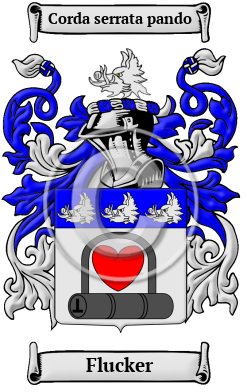
Etymology of FluckerWhat does the name Flucker mean? The ancestors of the first families to use the name Flucker lived in ancient Scotland in the kingdom of Dalriada. The name was then used as a nickname for a person who was brave. Flucker is a nickname surname, which belongs to the category of hereditary surnames. Nicknames form a broad and miscellaneous class of surnames, and can refer directly or indirectly to one's personality, physical attributes, mannerisms, or even their habits of dress. The surname Flucker comes from the words loc and hardy, which mean lock and brave or hardy. Flucker Coat of Arms CreationWhen the good Sir James Douglas fell in Spain, it was a Sir Simon Lochard who picked up the heart of Bruce in the locked silver casket and carried it back to Scotland. His name was changed to Lockhart to show that he was entrusted with the key, and though the crest most common to the Lockharts is a boar's head, yet in their arms they carry a human heart in a fetterlock. The motto, quite appropriately, is " Corda serrata pando " (I lay open a heart shut up). 1 Early Origins of the Flucker familyThe surname Flucker was first found in Lanarkshire (Gaelic: Siorrachd Lannraig) a former county in the central Strathclyde region of Scotland, now divided into the Council Areas of North Lanarkshire, South Lanarkshire, and the City of Glasgow, where this distinguished family acquired the estates of Carnwath, Cleghorn, Birkhill, Kirktoun, and Leigh. The Lockharts of Leigh 2 trace their descent from Sir Simon Locard whose name some claim was derived from the territorial name "de Loch Ard." The family estate was centered at Lee Castle, originally built c. 1272 and was expanded in the 19th century. Sir Simon Locard accompanied Sir James Douglas on his expedition with the heart of Robert the Bruce, which after Douglas' death brought home from Spain and buried in Melrose Abbey. This incident was the reason of the Arms' "man's heart within a fetterlock." The Flockhart variant occurs "as Fluckart in Edinburgh, 1679" and "Robert Flockhart, 'Daddy Flockhart' (1777-1857), [was] a street preacher in Edinburgh." 3 Early History of the Flucker familyThis web page shows only a small excerpt of our Flucker research. Another 108 words (8 lines of text) covering the years 1296, 1621, 1630, 1646, 1652, 1658, 1674, 1675, 1685, 1686, 1689 and 1890 are included under the topic Early Flucker History in all our PDF Extended History products and printed products wherever possible. Flucker Spelling VariationsIn various documents Flucker has been spelled Since medieval scribes still spelled according to sound, records from that era contain an enormous number of spelling variations. Lockhart, Lockhard, Locard, Lockard, Lockheart and many more. Early Notables of the Flucker familyGeorge Lockhart of Tarbrax (died 1658), Commissioner of Glasgow in the Parliament of Scotland (1646-1658); Sir James Lockhart of Lee (d. 1674), lord of the Court of Session, he held the judicial title Lord Lee; Sir William Lockhart of Lee (1621-1675), who married Oliver Cromwell's niece, and later became...
Another 49 words (4 lines of text) are included under the topic Early Flucker Notables in all our PDF Extended History products and printed products wherever possible. Migration of the Flucker family to IrelandSome of the Flucker family moved to Ireland, but this topic is not covered in this excerpt.
Another 59 words (4 lines of text) about their life in Ireland is included in all our PDF Extended History products and printed products wherever possible.
| Flucker migration to the United States | + |
Many who arrived from Scotland settled along the east coast of North America in communities that would go on to become the backbones of the young nations of the United States and Canada. In the American War of Independence, many settlers who remained loyal to England went north to Canada as United Empire Loyalists. Their descendants later began to recover the lost Scottish heritage through events such as the highland games that dot North America in the summer months. Research into various historical records revealed some of first members of the Flucker family emigrate to North America:
Flucker Settlers in United States in the 19th Century- Gregor Flucker, who landed in Allegany (Allegheny) County, Pennsylvania in 1856 4
The motto was originally a war cry or slogan. Mottoes first began to be shown with arms in the 14th and 15th centuries, but were not in general use until the 17th century. Thus the oldest coats of arms generally do not include a motto. Mottoes seldom form part of the grant of arms: Under most heraldic authorities, a motto is an optional component of the coat of arms, and can be added to or changed at will; many families have chosen not to display a motto.
Motto: Corda serrata pando
Motto Translation: I lay open locked hearts.
- Polson, Alexander, The Romance of Scottish Crests and Mottoes. Inverness: Walter Alexander, Inglis Street 1929. Print
- Lee, Sir Stanley, Dictionary of National Biography. London: The MacMillan Company 1909. Print
- Black, George F., The Surnames of Scotland Their Origin, Meaning and History. New York: New York Public Library, 1946. Print. (ISBN 0-87104-172-3)
- Filby, P. William, Meyer, Mary K., Passenger and immigration lists index : a guide to published arrival records of about 500,000 passengers who came to the United States and Canada in the seventeenth, eighteenth, and nineteenth centuries. 1982-1985 Cumulated Supplements in Four Volumes Detroit, Mich. : Gale Research Co., 1985, Print (ISBN 0-8103-1795-8)
 |