| ![Show Contents]() Fersin History, Family Crest & Coats of Arms Fersin History, Family Crest & Coats of Arms
- Origins Available:
Scotland
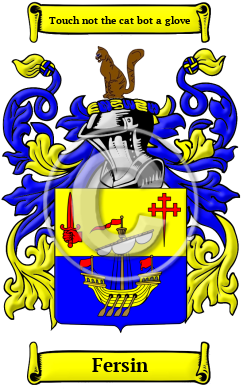
Etymology of FersinWhat does the name Fersin mean? The ancestors of the Fersin surname date back to the Pictish clans of ancient Scotland, Fersin was used as a name for a parson. The Gaelic forms of the names are Mac a' Phearsain and Mac a Phearsoin, which mean son of the parson. This was the surname of various ecclesiastical families in Scotland and is descended from a Chief of the great Clan Chattan ('tribe of the cats'), called Gille Chattan. This Chief can, in turn, be traced back to Feachar the Long, King of Lorn who died in 697 AD. The Clan's original territories were in Stratthnairn, Strathdearn and Badenoch from whence they long contested the leadership of the Clan Chattan with the MacKintoshes, who also claimed descent from the Gille Chattan through a female heiress. Fersin Coat of Arms CreationThe Macphersons carry a cat as their crest, and their motto is " Touch not the cat bot (without) a glove." The story is that young Angus Oig Macdonald went over to Ireland to help an Irish king, and there he got the king's daughter in marriage. While the clansmen after the nuptials were waiting to return to Scotland, there came into the camp an Irish piper, a Macneil, who managed to smuggle himself into one of the boats. A black cat followed, and when a Highlander tried to catch and throw it overboard, he got badly scratched for his pains, and the piper gave him the advice which became the motto of the clan, and the black cat accompanied them to Scotland. This piper when in Scotland took to preaching, married, and settled among the Argyllshire MacDonalds. His sons were known as Mhic a Pharson, and thus the Clan Macpherson originated. The clan has a galley in its coat of arms, perhaps in memory of the trip to Ireland, or perhaps to their being once driven by stress of weather on to the coast of Caithness. They also carry a dagger, point up, for killing the Cummings, and " a black cat for luck " has been a proverb, for the Macphersons have been lucky since they settled in Scotland. They are a branch of the great Clan Chattan. 1 Early Origins of the Fersin familyThe surname Fersin was first found in Inverness, where they were hereditary keepers of the sacred stone of St. Catan, and early Chief of the Clan Chattan. The MacPhersons are sometimes called the Clan Mhuirich, 'the children of Muredach,' from an early Chief of the Clan, Duncan (the Parson) who was imprisoned with the Lord of the Isles after the Battle of Harlaw (1411). Early History of the Fersin familyThis web page shows only a small excerpt of our Fersin research. Another 524 words (37 lines of text) covering the years 1490, 1528, 1600, 1645, 1672, 1675, 1688, 1689, 1700, 1715, 1745, 1776, 1783, 1784 and 1932 are included under the topic Early Fersin History in all our PDF Extended History products and printed products wherever possible. Fersin Spelling VariationsIn the Middle ages, spelling and translation were not yet regulated by any general rules. spelling variations in names were common even among members of one family unit. Fersin has appeared MacPherson, McPherson, MacPhersone, Mac a' Phearsoin (Gaelic) and many more. Early Notables of the Fersin familyJames MacPherson (1675-1700), the Scottish outlaw, famed for his Lament or Rant supposedly written on the eve of his execution, a version of which was rewritten by Robert Burns; and Colonel Duncan MacPherson, the Clan Chief, who commanded a battalion in North America from 1776 to...
Another 45 words (3 lines of text) are included under the topic Early Fersin Notables in all our PDF Extended History products and printed products wherever possible. Migration of the Fersin familyFaced by this persecution and the generally unstable political climate of those days, many Scots chose to leave their homeland for Ireland, Australia, and North America in search of greater opportunity and freedom. The colonies across the Atlantic were the most popular choice, but a passage there was neither cheap nor easily suffered. Passengers arrived sick and poor, but those who made it intact often found land and more tolerant societies in which to live. These brave settlers formed the backbone of the burgeoning nations of Canada and the United States. It is only this century that the ancestors of these families have begun to recover their collective identity through the patriotic highland games and Clan societies that have sprung up throughout North America. Research into early immigration and passenger lists revealed many immigrants bearing the name Fersin: Aeneas MacPherson, who arrived in Pennsylvania in 1685; Alexander McPherson, who settled in south Carolina in 1716; along with Angus, Daniel, Donald, Duncan, John.
| Fersin Motto and War Cry | + |
The motto was originally a war cry or slogan. Mottoes first began to be shown with arms in the 14th and 15th centuries, but were not in general use until the 17th century. Thus the oldest coats of arms generally do not include a motto. Mottoes seldom form part of the grant of arms: Under most heraldic authorities, a motto is an optional component of the coat of arms, and can be added to or changed at will; many families have chosen not to display a motto.
Motto: Touch not the cat bot a glove
Motto Translation: Touch not the cat without a glove
War Cry: "Craigdhu."
- Polson, Alexander, The Romance of Scottish Crests and Mottoes. Inverness: Walter Alexander, Inglis Street 1929. Print
 |