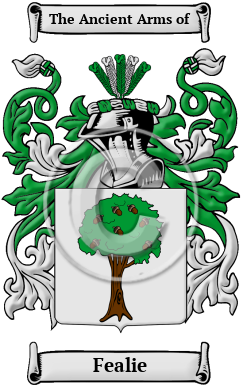
Hundreds of years ago, the Gaelic name used by the Fealie family in Ireland was "Mac Fithcheallaigh," from the word "fithcheallach," referring to a chess player.
Loading...
Early Origins of the Fealie family
The surname Fealie was first found in counties Donegal and Derry, where they held a family seat from very ancient times.
Early History of the Fealie family
This web page shows only a small excerpt of our Fealie research. Another 127 words (9 lines of text) covering the years 1516, 1548, 1555, 1559, 1567 and 1626 are included under the topic Early Fealie History in all our PDF Extended History products and printed products wherever possible.
Fealie Spelling Variations
Names from the Middle Ages demonstrate many spelling variations. This is because the recording scribe or church official often decided as to how a person's name was spelt and in what language. Research into the name Fealie revealed many variations, including Feeley, Fealy, Feally, Feely, Fehilly, Fehley, Feley, O'Feeley, O'Feely and many more.
Early Notables of the Fealie family
More information is included under the topic Early Fealie Notables in all our PDF Extended History products and printed products wherever possible.
Loading...
Loading...
Loading...
Loading...
Migration of the Fealie family
The 19th century saw a great wave of Irish families leaving Ireland for the distant shores of North America and Australia. These families often left their homeland hungry, penniless, and destitute due to the policies of England. Those Irish immigrants that survived the long sea passage initially settled on the eastern seaboard of the continent. Some, however, moved north to a then infant Canada as United Empire Loyalists after ironically serving with the English in the American War of Independence. Others that remained in America later joined the westward migration in search of land. The greatest influx of Irish immigrants, though, came to North America during the Great Potato Famine of the late 1840s. Thousands left Ireland at this time for North America, and those who arrived were immediately put to work building railroads, coal mines, bridges, and canals. In fact, the foundations of today's powerful nations of the United States and Canada were to a larger degree built by the Irish. Archival documents indicate that members of the Fealie family relocated to North American shores quite early: Margaret Fihilly, and her four children who arrived in Charleston Massachusetts in 1803; Michael Feely, whose Oath of Allegiance was recorded in Philadelphia in 1802.