| ![Show Contents]() Farqerson History, Family Crest & Coats of Arms Farqerson History, Family Crest & Coats of Arms
- Origins Available:
Scotland
Ireland
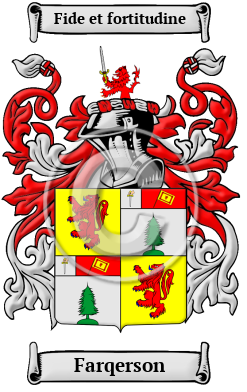
Etymology of FarqersonWhat does the name Farqerson mean? The name Farqerson is derived from the Gaelic MacFhearchair, which means 'son of Farquhar'. Farquhar is derived from the Gaelic word Fearchar, which means 'very dear one'. So, the name means 'son of the very dear one'. Farqerson Coat of Arms CreationAccording to Nisbet, the Farquharsons had a lion rampant in the shield because they were descended from MacDuff, the Earl of Fife ; a fir tree growing out of a mount because the Farquharsons' country abounded in trees; the banner of Scotland displayed because Finlay More was killed at. the battle of Pinkie holding the royal banner, and a dagger, point downwards, in remembrance of his ancestor of Rothiemurchus who joined the Macphersons in defeating Cumming of Strathbogie, the enemy of Robert the Bruce. 1 Early Origins of the Farqerson familyThe surname Farqerson was first found in Aberdeenshire (Gaelic: Siorrachd Obar Dheathain), a historic county, and present day Council Area of Aberdeen, located in the Grampian region of northeastern Scotland, where the family has a long and distinguished history dating back to the early Middle Ages. They claim descent from Farquhar Mackintosh who arrived in Braemar in 1382. The Clan was one of the principal members of the Clan Chattan (the Clan of the Cat), a powerful 26 Clan confederation. Accordingly, they rank as a sept of the Clan Chattan. Their alliance with the MacKintoshes was particularly strong and this proved quite advantageous, as the MacKintoshes were the captains of the Clan. Early History of the Farqerson familyThis web page shows only a small excerpt of our Farqerson research. Another 173 words (12 lines of text) covering the years 1350, 1699, 1782 and 1890 are included under the topic Early Farqerson History in all our PDF Extended History products and printed products wherever possible. Farqerson Spelling VariationsDuring the Middle Ages, there was no basic set of rules and scribes wrote according to sound. The correct spelling of Scottish names were further compromised after many haphazard translations from Gaelic to English and back. Spelling variations of the name Farqerson include Farquharson, Farqharson, Farquharsen, MacFhearchair (Gaelic), Caraher and many more. Early Notables of the Farqerson familyFindla Mor Farguharson who died at the Battle of Pinkie bearing the Royal Standard.
John Farquharson (1699-1782), was an outlawed Scottish Jesuit priest during the era of the...
Another 27 words (2 lines of text) are included under the topic Early Farqerson Notables in all our PDF Extended History products and printed products wherever possible. Migration of the Farqerson family to IrelandSome of the Farqerson family moved to Ireland, but this topic is not covered in this excerpt.
Another 34 words (2 lines of text) about their life in Ireland is included in all our PDF Extended History products and printed products wherever possible. Migration of the Farqerson familyScots left their country by the thousands to travel to Australia and North America. Desperate for freedom and an opportunity to fend for themselves, many paid huge fees and suffered under terrible conditions on long voyages. Still, for those who made the trip, freedom and opportunity awaited. In North America, many fought their old English oppressors in the American War of Independence. In recent years, Scottish heritage has been an increasingly important topic, as Clan societies and other organizations have renewed people's interest in their history. An examination of passenger and immigration lists shows many early settlers bearing the name of Farqerson: Harry Farquharson, who came to Virginia in 1716; Alexander Farquharson, who is on record in Halifax Nova Scotia in 1795; Alexander Farquharson, along with John, Donald, Duncan, Peter and William, were among Scots banished to the American Plantations (Barbados) in 1745-7. Other records show John Farquharsen settling in Savanna, Georgia in 1822.
| Farqerson Motto and War Cry | + |
The motto was originally a war cry or slogan. Mottoes first began to be shown with arms in the 14th and 15th centuries, but were not in general use until the 17th century. Thus the oldest coats of arms generally do not include a motto. Mottoes seldom form part of the grant of arms: Under most heraldic authorities, a motto is an optional component of the coat of arms, and can be added to or changed at will; many families have chosen not to display a motto.
Motto: Fide et fortitudine
Motto Translation: By fidelity and fortitude.
War Cry: "Cairn na Chuinhe"
War Cry Description: Translation: The cairn of remembrance
- Polson, Alexander, The Romance of Scottish Crests and Mottoes. Inverness: Walter Alexander, Inglis Street 1929. Print
 |