| ![Show Contents]() Fain History, Family Crest & Coats of Arms Fain History, Family Crest & Coats of Arms
Etymology of FainWhat does the name Fain mean? The surname Fain is derived from the Middle English words "fein," "fayn," or " fane," which all mean "glad." The name was a nickname for a happy or good-natured person. The name could also have been a local name derived from the expression "at the van" or in other words near the "threshing-floor" derived from the word "van" which was a threshing instrument. Early Origins of the Fain familyThe surname Fain was first found in Monmouthshire (Welsh: Sir Fynwy), where the ancestors of the earls of Westmorland, "wrote their name Vane, and descended from Howel ap Vane, living there before the time of William the Conqueror" 1 living about the year 1060. Another reference states: "The Fanes or Vanes are said to have originated from Wales; in the reign of Henry VI, they were seated at Hilden in Tunbridge, in Kent, by marriage with the Peshalls." 2 Early History of the Fain familyThis web page shows only a small excerpt of our Fain research. Another 130 words (9 lines of text) covering the years 1538, 1580, 1589, 1602, 1607, 1613, 1616, 1625, 1626, 1629, 1639, 1645, 1653, 1655, 1662, 1663, 1666, 1680, 1681, 1682, 1689, 1693, 1708, 1710, 1715, 1721, 1723, 1727 and 1734 are included under the topic Early Fain History in all our PDF Extended History products and printed products wherever possible. Fain Spelling VariationsThe Welsh have an extremely large amount of spelling variations of their native surnames to their credit. Priests or the scribes determined how the spoken name was to be made literal. As time progressed, the old Brythonic names of Wales were recorded in English, which was especially problematic since the English language had extreme difficulty recording the highly inflected sounds of Cymraeg. Spelling variations were, however, also carried out according to an individual's design: a branch loyalty within the family, a religious adherence, or even patriotic affiliations could be indicated by spelling variations of one's name. The spelling variations of the name Fain have included Fane, Ap Fane, Fain, Vane, Vain, Veynes, Vanes and others. Early Notables of the Fain familyFrancis Fane (1580-1629), 1st Earl of Westmorland (second creation); Mildmay Fane, 2nd Earl of Westmorland (1602-1666), an English nobleman, politician, and writer; Lady Mary Fane (1639-1681) was the daughter of Mildmay Fane, 2nd Earl of Westmorland; Sir Henry Vane the Elder (1589-1655), English courtier, father of Henry Vane the Younger; Sir Henry Vane the Younger (1613-1662), statesman, Puritan, son of Henry Vane the Elder; and his son, Christopher Vane, 1st Baron Barnard (1653-1723), an English peer; George Fane (c. 1616-1663) was an English politician who fought for the Royalist army in the English Civil War; The Honourable Mildmay Fane (1689-1715), a...
Another 141 words (10 lines of text) are included under the topic Early Fain Notables in all our PDF Extended History products and printed products wherever possible. Fain RankingIn the United States, the name Fain is the 3,469th most popular surname with an estimated 9,948 people with that name. 3 Migration of the Fain family to IrelandSome of the Fain family moved to Ireland, but this topic is not covered in this excerpt. More information about their life in Ireland is included in all our PDF Extended History products and printed products wherever possible.
| Fain migration to the United States | + |
North America in the 1800s and 1900s saw the arrival of many Welsh people hoping to share in the wealth of land, work, and freedom that they felt North America held. Those who made the journey often attained those expectations, but only through an enormous amount of hard work, perseverance, and often a bout of good luck. These immigrants helped contribute to the growth of industry, commerce, and culture of both Canada and the United States. Discovered in the immigration and passenger lists were a number of people bearing the name Fain:
Fain Settlers in United States in the 17th Century- Mary Fain, who landed in Virginia in 1663 4
Fain Settlers in United States in the 18th Century- Thomas Fain, who arrived in Virginia in 1705 4
Fain Settlers in United States in the 19th Century- Johann Stephan Fain, who landed in Ohio in 1833 4
- Jacob Fain, aged 41, who arrived in New York, NY in 1884 4
- A. Fain, aged 52, who landed in America, in 1893
- David Fain, aged 23, who immigrated to the United States, in 1895
- Golde Fain, aged 19, who landed in America, in 1895
- ... (More are available in all our PDF Extended History products and printed products wherever possible.)
Fain Settlers in United States in the 20th Century- Emil Fain, aged 17, who landed in America, in 1905
- Abram Fain, aged 17, who immigrated to the United States from Sylma, Poland, in 1920
- Adolfo Fain, aged 25, who landed in America, in 1920
- Betty Fain, aged 10, who settled in America, in 1922
- Elizabeth Fain, aged 47, who immigrated to the United States, in 1922
- ... (More are available in all our PDF Extended History products and printed products wherever possible.)
| Fain migration to Australia | + |
Fain Settlers in Australia in the 19th Century
| Contemporary Notables of the name Fain (post 1700) | + |
- Holley Fain (b. 1981), American actress, best known for her role on the ABC's drama series Grey's Anatomy
- Melanie Ann "Huckaby" Fain (b. 1958), American printmaker
- Richard Alexander Fain (b. 1968), retired American college and NFL football player
- Ferris Roy Fain (1921-2001), American Major League Baseball first baseman
- Sammy Fain (1902-1989), born Samuel E. Feinberg, American composer
- Mabel Louise Fain (1904-1997), American Republican politician, Delegate to Republican National Convention from Oklahoma, 1944 6
- John A. Fain, American politician, U.S. Attorney for the Western District of Oklahoma, 1914-20 7
- James R. Fain, American politician, Mayor of Winston-Salem, North Carolina, 1939-41 7
- G. J. Fain, American Democratic Party politician, Delegate to Democratic National Convention from Georgia, 1860 7
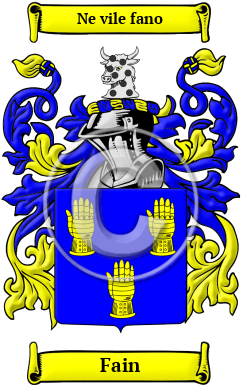
The motto was originally a war cry or slogan. Mottoes first began to be shown with arms in the 14th and 15th centuries, but were not in general use until the 17th century. Thus the oldest coats of arms generally do not include a motto. Mottoes seldom form part of the grant of arms: Under most heraldic authorities, a motto is an optional component of the coat of arms, and can be added to or changed at will; many families have chosen not to display a motto.
Motto: Ne vile fano
Motto Translation: Bring nothing base to the template.
| Suggested Readings for the name Fain | + |
- Fain Family 1980 by Jeanette Fain Cornelius.
- Lower, Mark Anthony, Patronymica Britannica, A Dictionary of Family Names of the United Kingdom. London: John Russel Smith, 1860. Print.
- Shirley, Evelyn Philip, The Noble and Gentle Men of England; The Arms and Descents. Westminster: John Bower Nichols and Sons, 1866, Print.
- "What are the 5,000 Most Common Last Names in the U.S.?". NameCensus.com, https://namecensus.com/last-names/
- Filby, P. William, Meyer, Mary K., Passenger and immigration lists index : a guide to published arrival records of about 500,000 passengers who came to the United States and Canada in the seventeenth, eighteenth, and nineteenth centuries. 1982-1985 Cumulated Supplements in Four Volumes Detroit, Mich. : Gale Research Co., 1985, Print (ISBN 0-8103-1795-8)
- Convict Records Voyages to Australia (Retrieved 11th March 2022). Retrieved from https://convictrecords.com.au/ships/elizabeth
- The Political Graveyard: Alphabetical Name Index. (Retrieved 2016, March 16) . Retrieved from http://politicalgraveyard.com/alpha/index.html
 |