
Show ContentsEseler History, Family Crest & Coats of Arms

Etymology of Eseler

What does the name Eseler mean?

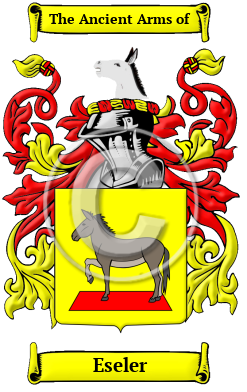
The name Eseler is most likely an occupational name. The Teutonic tribes spoke Old Saxon, an early form of Low-German, and they used the words "esil-herdi" (donkey herder) to refer to the persons who reared donkeys for Cavalry support. Another source notes the name could be from the Middle High German esel, 'donkey' + the agent suffix -er. 1

Early Origins of the Eseler family

The surname Eseler was first found in the ancient region of Saxony, and the Teutonic tribes, who inhabited the Elbe and Wesser valleys. Saxony was originally the name of a territory in the north-west of Germany, that also contained the duchies of Westphalia and Brunswick until the 12th and 13th centuries.

Some of the family branched to Nuremberg in Bavaria and others fled to Ireland and Scotland due to religious persecution. The Irish branch which settled mostly in County Antrim mostly arrived at about the time of the Plantation of Ulster and took advantage of the land offer at that time having been brought by Protestant refugees from Catholic states in Germany. 1

Early History of the Eseler family

This web page shows only a small excerpt of our Eseler research. Another 32 words (2 lines of text) covering the year 1339 is included under the topic Early Eseler History in all our PDF Extended History products and printed products wherever possible.

Eseler Spelling Variations

Spelling variations of this family name include: Esolherde, Eseler, Esler and others.

Early Notables of the Eseler family

More information is included under the topic Early Eseler Notables in all our PDF Extended History products and printed products wherever possible.

Migration of the Eseler family

Some of the first settlers of this family name or some of its variants were: John Esler, who arrived in Philadelphia in 1749 with his family, W. Esler, who arrived in New York city in 1850, and Christian Esler, who was recorded in North Carolina in 1710..


  1. Bahlow, Hans, Dictionary of German Names. translated by Edda Gentry, Wisconsin: The Board of Regents of the University of Wisconsin System, 2002. Print. (ISBN 0-924119-35-7)


Houseofnames.com on Facebook