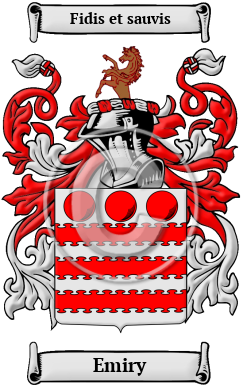
| ![Show Contents]() Emiry History, Family Crest & Coats of Arms Emiry History, Family Crest & Coats of Arms
- Origins Available:
England
Etymology of EmiryWhat does the name Emiry mean? Emiry is a name that dates far back into the mists of early British history to the days of the Anglo-Saxon tribes. It is derived from an ancient Saxon Chieftain named Almericus. In Old English, patronyms were formed by adding a variety of suffixes to personal names, which changed over time and from place to place. For example, after the Norman Conquest, sunu and sune, which meant son, were the most common patronymic suffixes. In the 12th and 13th centuries, the most common patronymic names included the word filius, which meant son. By the 14th century, the suffix son had replaced these earlier versions. Surnames that were formed with filius or son were more common in the north of England and it was here that the number of individuals without surnames was greatest at this time. Early Origins of the Emiry familyThe surname Emiry was first found in the Domesday Book of 1086 where the singular Latin form Amalricus was listed. 1 Later in Lincolnshire, in the forename form, Ymnerus filius Reineri was listed c. 1160. The singular Haimeri was found in the Pipe Rolls for Staffordshire in 1170 and a few years later, Haimericus filius Gidhe was found in Lincolnshire c. 1190-1195. We must look to Northumberland in the Curia Regis Rolls 1207-1214 to see the name with early surname spellings: Robertus filius Amalrici, Almarici, Aumarici. Aymery de Rupe Cawardi was found in the Assize Rolls for Somerset in 1278; Roger Hemeri in Clerkenwell, Essex c. 1182; Robert Amalri in the Curia Regis Rolls for Oxfordshire in 1207; Richard Aumauri in the Curia Regis Rolls for Dorset in 1221; Robert Emeri in Leicestershire in 1223; Robert Heymeri in Cheshire in 1240; Simon Amarik in the Assize Rolls for Yorkshire in 1260; William Emeric in 1276; and Robert Amary, Amory in the Hundredorum Rolls for Berkshire in 1279. 2 Early History of the Emiry familyThis web page shows only a small excerpt of our Emiry research. Another 73 words (5 lines of text) covering the years 1777, 1792, 1793, 1802, 1822, 1825, 1842 and 1850 are included under the topic Early Emiry History in all our PDF Extended History products and printed products wherever possible. Emiry Spelling VariationsIt is only in the last few hundred years that the English language has been standardized. For that reason, early Anglo-Saxon surnames like Emiry are characterized by many spelling variations. As the English language changed and incorporated elements of other European languages, even literate people changed the spelling of their names. The variations of the name Emiry include: Emery, Emmery, Emory, Emmory, Emerye, Emmerie and others. Early Notables of the Emiry familyJohn Emery (1777-1822), actor, born at Sunderland 22 Sept. 1777, and obtained a rudimentary education at Ecclesfield in the West Riding of Yorkshire. His father, Mackle Emery (d. 18 May 1825), was a country actor, and his mother, as Mrs. Emery, sen., appeared 6 July 1802 at the Haymarket as Dame Ashfield in Morton's 'Speed the Plough,' and subsequently played at Covent Garden. Emery was brought up for a musician, and when twelve years of age was in the orchestra at the Brighton theatre. At this house he made his first appearance as Old Crazy in the farce of 'Peeping Tom.'...
Another 287 words (20 lines of text) are included under the topic Early Emiry Notables in all our PDF Extended History products and printed products wherever possible.
| Emiry migration to the United States | + |
Many English families tired of political and religious strife left Britain for the new colonies in North America. Although the trip itself offered no relief - conditions on the ships were extremely cramped, and many travelers arrived diseased, starving, and destitute - these immigrants believed the opportunities that awaited them were worth the risks. Once in the colonies, many of the families did indeed prosper and, in turn, made significant contributions to the culture and economies of the growing colonies. An inquiry into the early roots of North American families has revealed a number of immigrants bearing the name Emiry or a variant listed above:
Emiry Settlers in United States in the 18th Century- James Emiry, aged 20, who arrived in New York in 1774 3
The motto was originally a war cry or slogan. Mottoes first began to be shown with arms in the 14th and 15th centuries, but were not in general use until the 17th century. Thus the oldest coats of arms generally do not include a motto. Mottoes seldom form part of the grant of arms: Under most heraldic authorities, a motto is an optional component of the coat of arms, and can be added to or changed at will; many families have chosen not to display a motto.
Motto: Fidis et sauvis
Motto Translation: Faith and sweet
- Williams, Dr Ann. And G.H. Martin, Eds., Domesday Book A Complete Translation. London: Penguin, 1992. Print. (ISBN 0-141-00523-8)
- Reaney, P.H and R.M. Wilson, A Dictionary of English Surnames. London: Routledge, 1991. Print. (ISBN 0-415-05737-X)
- Filby, P. William, Meyer, Mary K., Passenger and immigration lists index : a guide to published arrival records of about 500,000 passengers who came to the United States and Canada in the seventeenth, eighteenth, and nineteenth centuries. 1982-1985 Cumulated Supplements in Four Volumes Detroit, Mich. : Gale Research Co., 1985, Print (ISBN 0-8103-1795-8)
 |