| ![Show Contents]() Emiray History, Family Crest & Coats of Arms Emiray History, Family Crest & Coats of Arms
- Origins Available:
England
Etymology of EmirayWhat does the name Emiray mean? The Anglo-Saxon name Emiray comes from an ancient Saxon Chieftain named Almericus. In Old English, patronyms were formed by adding a variety of suffixes to personal names, which changed over time and from place to place. For example, after the Norman Conquest, sunu and sune, which meant son, were the most common patronymic suffixes. In the 12th and 13th centuries, the most common patronymic names included the word filius, which meant son. By the 14th century, the suffix son had replaced these earlier versions. Surnames that were formed with filius or son were more common in the north of England and it was here that the number of individuals without surnames was greatest at this time. Early Origins of the Emiray familyThe surname Emiray was first found in the Domesday Book of 1086 where the singular Latin form Amalricus was listed. 1 Later in Lincolnshire, in the forename form, Ymnerus filius Reineri was listed c. 1160. The singular Haimeri was found in the Pipe Rolls for Staffordshire in 1170 and a few years later, Haimericus filius Gidhe was found in Lincolnshire c. 1190-1195. We must look to Northumberland in the Curia Regis Rolls 1207-1214 to see the name with early surname spellings: Robertus filius Amalrici, Almarici, Aumarici. Aymery de Rupe Cawardi was found in the Assize Rolls for Somerset in 1278; Roger Hemeri in Clerkenwell, Essex c. 1182; Robert Amalri in the Curia Regis Rolls for Oxfordshire in 1207; Richard Aumauri in the Curia Regis Rolls for Dorset in 1221; Robert Emeri in Leicestershire in 1223; Robert Heymeri in Cheshire in 1240; Simon Amarik in the Assize Rolls for Yorkshire in 1260; William Emeric in 1276; and Robert Amary, Amory in the Hundredorum Rolls for Berkshire in 1279. 2 Early History of the Emiray familyThis web page shows only a small excerpt of our Emiray research. Another 73 words (5 lines of text) covering the years 1777, 1792, 1793, 1802, 1822, 1825, 1842 and 1850 are included under the topic Early Emiray History in all our PDF Extended History products and printed products wherever possible. Emiray Spelling VariationsOne relatively recent invention that did much to standardize English spelling was the printing press. However, before its invention even the most literate people recorded their names according to sound rather than spelling. The spelling variations under which the name Emiray has appeared include Emery, Emmery, Emory, Emmory, Emerye, Emmerie and others. Early Notables of the Emiray familyJohn Emery (1777-1822), actor, born at Sunderland 22 Sept. 1777, and obtained a rudimentary education at Ecclesfield in the West Riding of Yorkshire. His father, Mackle Emery (d. 18 May 1825), was a country actor, and his mother, as Mrs. Emery, sen., appeared 6 July 1802 at the Haymarket as Dame Ashfield in Morton's 'Speed the Plough,' and subsequently played at Covent Garden. Emery was brought up for a musician, and when twelve years of age was in the orchestra at the Brighton theatre. At this house he made his first appearance as Old Crazy in the farce of 'Peeping Tom.'...
Another 287 words (20 lines of text) are included under the topic Early Emiray Notables in all our PDF Extended History products and printed products wherever possible. Migration of the Emiray familyAt this time, the shores of the New World beckoned many English families that felt that the social climate in England was oppressive and lacked opportunity for change. Thousands left England at great expense in ships that were overcrowded and full of disease. A great portion of these settlers never survived the journey and even a greater number arrived sick, starving, and without a penny. The survivors, however, were often greeted with greater opportunity than they could have experienced back home. These English settlers made significant contributions to those colonies that would eventually become the United States and Canada. An examination of early immigration records and passenger ship lists revealed that people bearing the name Emiray arrived in North America very early: Andrew Emery who settled in Virginia in 1638; Anthony Emery settled in New England in 1630; Francis settled in Salem Massachusetts in 1635; James settled in Boston Massachusetts in 1635.
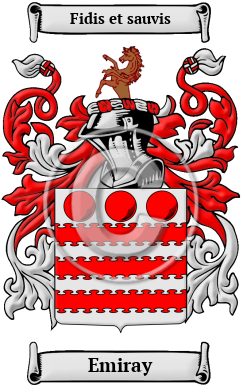
The motto was originally a war cry or slogan. Mottoes first began to be shown with arms in the 14th and 15th centuries, but were not in general use until the 17th century. Thus the oldest coats of arms generally do not include a motto. Mottoes seldom form part of the grant of arms: Under most heraldic authorities, a motto is an optional component of the coat of arms, and can be added to or changed at will; many families have chosen not to display a motto.
Motto: Fidis et sauvis
Motto Translation: Faith and sweet
- Williams, Dr Ann. And G.H. Martin, Eds., Domesday Book A Complete Translation. London: Penguin, 1992. Print. (ISBN 0-141-00523-8)
- Reaney, P.H and R.M. Wilson, A Dictionary of English Surnames. London: Routledge, 1991. Print. (ISBN 0-415-05737-X)
 |