
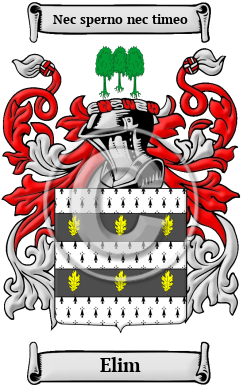
Show ContentsElim History, Family Crest & Coats of Arms

Early Origins of the Elim family

The surname Elim was first found in Berwickshire where they held a family seat from very ancient times, some say well before the Norman Conquest and the arrival of Duke William at Hastings in 1066 A.D.

Early History of the Elim family

This web page shows only a small excerpt of our Elim research. Another 88 words (6 lines of text) covering the years 1296 and 1463 are included under the topic Early Elim History in all our PDF Extended History products and printed products wherever possible.

Elim Spelling Variations

During the era when a person's name, tribe and posterity was one of his most important possessions, many different spellings were found in the archives examined. Elim occurred in many references, and spelling variations of the name found included Ellem, Ellim, Ellam, Ellames, Ellams, Ellems and others.

Early Notables of the Elim family

More information is included under the topic Early Elim Notables in all our PDF Extended History products and printed products wherever possible.

Migration of the Elim family

Gradually becoming disenchanted with life in Ireland many of these uprooted families sailed aboard the armada of sailing ships known as the "White Sails" which plied the stormy Atlantic. These overcrowded ships often arrived with only 60 to 70% of their original passenger list, many dying of illness and the elements, were buried at sea. In North America, early immigrants bearing the family name Elim, or a spelling variation of the surname include: Charles Ellam who settled in Philadelphia in 1858.


Contemporary Notables of the name Elim (post 1700) +

  • Elim J. Hawbaker, American Republican politician, Delegate to Republican National Convention from Illinois, 1912, 1928 (alternate) 1
  • Elim O'Shaughnessy, American politician, U.S. Vice Consul in Warsaw, 1938; Rio de Janeiro, 1939-43 2


The Elim Motto +

The motto was originally a war cry or slogan. Mottoes first began to be shown with arms in the 14th and 15th centuries, but were not in general use until the 17th century. Thus the oldest coats of arms generally do not include a motto. Mottoes seldom form part of the grant of arms: Under most heraldic authorities, a motto is an optional component of the coat of arms, and can be added to or changed at will; many families have chosen not to display a motto.

Motto: Nec sperno nec timeo
Motto Translation: I neither despise nor fear.


  1. The Political Graveyard: Alphabetical Name Index. (Retrieved 2016, January 14) . Retrieved from http://politicalgraveyard.com/alpha/index.html
  2. The Political Graveyard: Alphabetical Name Index. (Retrieved 2015, November 10) . Retrieved from http://politicalgraveyard.com/alpha/index.html


Houseofnames.com on Facebook