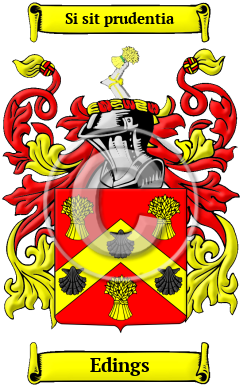
| ![Show Contents]() Edings History, Family Crest & Coats of Arms Edings History, Family Crest & Coats of Arms
- Origins Available:
England
Etymology of EdingsWhat does the name Edings mean? The name is derived from the Old English personal name Eadda, and means "son of Eadda." Early Origins of the Edings familyThe surname Edings was first found in Cambridgeshire, where John Edyng was recorded in the Subsidy Rolls of 1327. 1 Early History of the Edings familyThis web page shows only a small excerpt of our Edings research. Another 32 words (2 lines of text) covering the year 1641 is included under the topic Early Edings History in all our PDF Extended History products and printed products wherever possible. Edings Spelling VariationsSound was what guided spelling in the essentially pre-literate Middle Ages, so one person's name was often recorded under several variations during a single lifetime. Also, before the advent of the printing press and the first dictionaries, the English language was not standardized. Therefore, spelling variations were common, even among the names of the most literate people. Known variations of the Edings family name include Edding, Eddings, Edyngs, Edings and others. Early Notables of the Edings familyMore information is included under the topic Early Edings Notables in all our PDF Extended History products and printed products wherever possible.
| Edings migration to the United States | + |
For political, religious, and economic reasons, thousands of English families boarded ships for Ireland, Canada, the America colonies, and many of smaller tropical colonies in the hope of finding better lives abroad. Although the passage on the cramped, dank ships caused many to arrive in the New World diseased and starving, those families that survived the trip often went on to make valuable contributions to those new societies to which they arrived. Early immigrants bearing the Edings surname or a spelling variation of the name include:
Edings Settlers in United States in the 18th Century- Robert Edings, who arrived in Virginia in 1703 2
The motto was originally a war cry or slogan. Mottoes first began to be shown with arms in the 14th and 15th centuries, but were not in general use until the 17th century. Thus the oldest coats of arms generally do not include a motto. Mottoes seldom form part of the grant of arms: Under most heraldic authorities, a motto is an optional component of the coat of arms, and can be added to or changed at will; many families have chosen not to display a motto.
Motto: Si sit prudentia
Motto Translation: If there be prudence.
- Reaney, P.H and R.M. Wilson, A Dictionary of English Surnames. London: Routledge, 1991. Print. (ISBN 0-415-05737-X)
- Filby, P. William, Meyer, Mary K., Passenger and immigration lists index : a guide to published arrival records of about 500,000 passengers who came to the United States and Canada in the seventeenth, eighteenth, and nineteenth centuries. 1982-1985 Cumulated Supplements in Four Volumes Detroit, Mich. : Gale Research Co., 1985, Print (ISBN 0-8103-1795-8)
 |