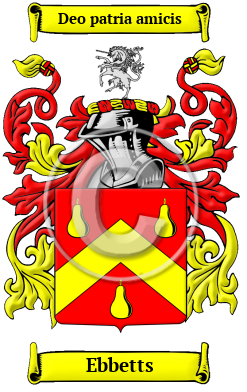
| ![Show Contents]() Ebbetts History, Family Crest & Coats of Arms Ebbetts History, Family Crest & Coats of Arms
Etymology of EbbettsWhat does the name Ebbetts mean? The surname Ebbetts, comes from the Old English word "abbod," which in turn comes from a Latin and a Greek root, and means "priest." The celibacy of the clergy makes it unlikely that this name is actually an occupational name for a priest, but rather was likely a name first used by someone who employed by the church, or someone thought to resemble an abbot in some way. Early Origins of the Ebbetts familyThe surname Ebbetts was first found in the counties of Oxfordshire, Huntingdon, Bedfordshire and Cambridge from very ancient times, before the Norman Conquest of England by Duke William of Normandy in 1066 A.D. Early History of the Ebbetts familyThis web page shows only a small excerpt of our Ebbetts research. Another 75 words (5 lines of text) covering the years 1306, 1577, 1611 and 1912 are included under the topic Early Ebbetts History in all our PDF Extended History products and printed products wherever possible. Ebbetts Spelling VariationsSpelling variations of this family name include: Abbott, Abbot, Abbotts, Abbett, Abbet, Abott and others. Early Notables of the Ebbetts familyMore information is included under the topic Early Ebbetts Notables in all our PDF Extended History products and printed products wherever possible. Migration of the Ebbetts family to IrelandSome of the Ebbetts family moved to Ireland, but this topic is not covered in this excerpt. More information about their life in Ireland is included in all our PDF Extended History products and printed products wherever possible.
| Ebbetts migration to the United States | + |
Ebbetts Settlers in United States in the 19th Century- Arthur M Ebbetts, who landed in San Francisco, California in 1849 1
- J A N Ebbetts, who arrived in San Francisco, California in 1851 1
- A M Ebbetts, who arrived in San Francisco, California in 1851 1
- Mr. Ebbetts, who landed in San Francisco, California in 1855 1
The motto was originally a war cry or slogan. Mottoes first began to be shown with arms in the 14th and 15th centuries, but were not in general use until the 17th century. Thus the oldest coats of arms generally do not include a motto. Mottoes seldom form part of the grant of arms: Under most heraldic authorities, a motto is an optional component of the coat of arms, and can be added to or changed at will; many families have chosen not to display a motto.
Motto: Deo patria amicis
Motto Translation: A friend to God and my country.
- Filby, P. William, Meyer, Mary K., Passenger and immigration lists index : a guide to published arrival records of about 500,000 passengers who came to the United States and Canada in the seventeenth, eighteenth, and nineteenth centuries. 1982-1985 Cumulated Supplements in Four Volumes Detroit, Mich. : Gale Research Co., 1985, Print (ISBN 0-8103-1795-8)
 |