| ![Show Contents]() Eare History, Family Crest & Coats of Arms Eare History, Family Crest & Coats of Arms
- Origins Available:
Scotland
Ireland
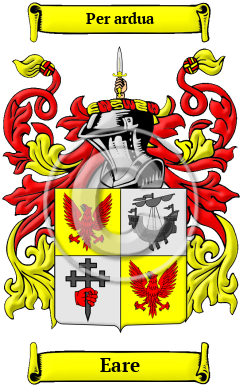
Etymology of EareWhat does the name Eare mean? The first family to use the name Eare lived in the area that was once the ancient Scottish kingdom of Dalriada. It is a name for a carpenter or wright. The Gaelic form Mac an t-saoir means son of the carpenter. Most historians agree that their earliest habitations were on MacDonald territories on Kintyre. Most legends about their beginnings point to an origin in the Hebrides. From this point on, opinions differ. One legend has the Clan-an-t-Saor (Children of the Carpenter) arriving in Lorne in a galley with a white cow, another says that the galley, set adrift, developed a leak below the water line and the MacDonald Chieftain placed his thumb in the hole to keep the boat afloat. Spotting help at a distance, he cut off his thumb so that he could wave. He was ironically named the Carpenter or MacIntyre. Some claim that the family derived its name from a member of the MacDonalds who was called Cean-tire because of his ownership of lands on the peninsula of Kintyre. Eare Coat of Arms CreationThe crest of this clan is a hand holding a dagger, and their motto, " Per Ardua" (Through difficulties), probably because they had success only by hard work. There are two legends as to how they got the name Macintyre. One is that at Creich, in Sutherland, one of the Clan Donald built a fort so well that he became known as "An Saor," Gaelic for "the carpenter," and his son as "Mac-an-shaor," which is pronounced very like Macintyre. The other story is that in coming over from Ireland the plug in the bottom of the boat was displaced and thrown overboard as they were baling. Having nothing handy to stop the in rushing water, the first Macintyre thrust his thumb into the hole, and when he found that his services were urgently needed in another part of the boat, he chopped it off, and the thumbless one was afterwards known as "An Saor." Perhaps it is to commemorate this that they have a galley with sails furled in their armorial bearings. 1 Early Origins of the Eare familyThe surname Eare was first found in Argyllshire (Gaelic erra Ghaidheal), the region of western Scotland corresponding roughly with the ancient Kingdom of Dál Riata, in the Strathclyde region of Scotland, now part of the Council Area of Argyll and Bute, where according legend, Maurice or Murdock, The Wright, (c.1150) became the first MacIntyre chief as a reward for helping his uncle, Somerled, King of Argyll and the Western Isles. Early History of the Eare familyThis web page shows only a small excerpt of our Eare research. Another 181 words (13 lines of text) covering the years 1543, 1597, 1890, 1955 and 1991 are included under the topic Early Eare History in all our PDF Extended History products and printed products wherever possible. Eare Spelling VariationsTranslation in medieval times was an undeveloped science and was often carried out without due care. For this reason, many early Scottish names appeared radically altered when written in English. The spelling variations of Eare include MacIntyre, MacIntire, MacIntre and many more. Early Notables of the Eare familyAnother 50 words (4 lines of text) are included under the topic Early Eare Notables in all our PDF Extended History products and printed products wherever possible. Migration of the Eare family to IrelandSome of the Eare family moved to Ireland, but this topic is not covered in this excerpt.
Another 59 words (4 lines of text) about their life in Ireland is included in all our PDF Extended History products and printed products wherever possible. Migration of the Eare familyMany settled along the east coast of what would become the United States and Canada. As the American War of Independence broke out, those who remained loyal to the crown went north to Canada as United Empire Loyalists. The ancestors of all of these hardy Dalriadan-Scottish settlers began to recover their collective history in the 20th century with the advent of the vibrant culture fostered by highland games and Clan societies in North America. Highland games, Clan societies, and other organizations generated much renewed interest in Scottish heritage in the 20th century. The Eare were among the earliest of the Scottish settlers as immigration passenger lists have shown: Angus McIntire settled in New York in 1739; along with Donald; Anne, Duncan, John, Margaret, Archibald, McIntire settled in Wilmington N.C. in 1775; Hugh McIntire settled in Virginia in 1716.
The motto was originally a war cry or slogan. Mottoes first began to be shown with arms in the 14th and 15th centuries, but were not in general use until the 17th century. Thus the oldest coats of arms generally do not include a motto. Mottoes seldom form part of the grant of arms: Under most heraldic authorities, a motto is an optional component of the coat of arms, and can be added to or changed at will; many families have chosen not to display a motto.
Motto: Per ardua
Motto Translation: Through difficulties.
- Polson, Alexander, The Romance of Scottish Crests and Mottoes. Inverness: Walter Alexander, Inglis Street 1929. Print
 |