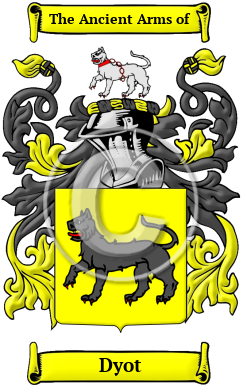
| ![Show Contents]() Dyot History, Family Crest & Coats of Arms Dyot History, Family Crest & Coats of Arms
Etymology of DyotWhat does the name Dyot mean? Dyot is a name of Anglo-Saxon origin. It was a name given to a person known for great strength. The surname Dyot originally derived from the Old English word Doegheard. Another source claims the name to be from 'the son of Dionisia," typically found in Yorkshire, England. 1 Early Origins of the Dyot familyThe surname Dyot was first found in Staffordshire at Freeford, a hamlet, in the parish of St. Michael, Lichfield, union of Lichfield, N. division of the hundred of Offlow. " The manor [of Freeford] was held by a family of its own name, in the reign of James I., and afterwards passed to the family of Dyott, who suffered much in the parliamentary war for their attachment to Charles I." 2 In Yorkshire, early records there show Dyett, Dyott (with no forename) recorded at Wakefield in 1296 and later Dyott was listed in the Subsidy Rolls for Cumberland in 1332. William Dyot was registered in 1348 as was Robert Diotte in Yorkshire in 1396. 3 The Yorkshire Poll Tax Rolls of 1379 included Diot Mason; Diot de Wodehous; Willelmus Wege, et Diot uxor ejus; Johannes Chetel, et Diot uxor ejus; and Robertus Diot, et MarIona uxor ejus. 1 A scan through records in Scotland revealed "Hew Dvat, smith in Balgray Mill, Ayrshire, 1669; Alexander Dyett or Dyet, councillor in Irvine, 1665 (may be Alexander Dyet, merchant burgess of Irvine, 1680); and Robert Dyett, portioner in Meikle Govan, 1772." 4 Early History of the Dyot familyThis web page shows only a small excerpt of our Dyot research. Another 76 words (5 lines of text) covering the years 1560, 1562, 1591, 1601, 1614, 1619, 1622, 1623, 1640, 1660, 1667, 1677, 1690, 1695 and 1719 are included under the topic Early Dyot History in all our PDF Extended History products and printed products wherever possible. Dyot Spelling VariationsBefore the last few hundred years, the English language had no fast system of spelling rules. For that reason, spelling variations are commonly found in early Anglo-Saxon surnames. Over the years, many variations of the name Dyot were recorded, including Dyott, Dyot, Diot and others. Early Notables of the Dyot family- General John Dyot, known as "Dumb éyort of Somerson"
- Anthony Dyott (c. 1560-1622) was an English lawyer and politician who sat in the House of Commons between 1601 and 1614
- Sir Richard Dyott (c. 1591-1660) was an English lawyer and politician who sat in the House of Commons between 1623 and 1640
- Richard Dyott (1619-1677), an English landowner and politician who sat in the House of Commons between 1667 and 1677
Migration of the Dyot familyTo escape oppression and starvation at that time, many English families left for the "open frontiers" of the New World with all its perceived opportunities. In droves people migrated to the many British colonies, those in North America in particular, paying high rates for passages in cramped, unsafe ships. Although many of the settlers did not make the long passage alive, those who did see the shores of North America perceived great opportunities before them. Many of the families that came from England went on to make essential contributions to the emerging nations of Canada and the United States. Research into various historical records revealed some of first members of the Dyot family emigrate to North America: John Dyett, who came to Maryland in 1661; Henry Dyet, who came to Virginia in 1741; Maxwell Dyett, who came to New York, NY in 1822; Thomas Dyott who settled in Philadelphia, Pennsylvania in 1811.
- Bardsley, C.W, A Dictionary of English and Welsh Surnames: With Special American Instances. Wiltshire: Heraldry Today, 1901. Print. (ISBN 0-900455-44-6)
- Lewis, Samuel, A Topographical Dictionary of England. Institute of Historical Research, 1848, Print.
- Reaney, P.H and R.M. Wilson, A Dictionary of English Surnames. London: Routledge, 1991. Print. (ISBN 0-415-05737-X)
- Black, George F., The Surnames of Scotland Their Origin, Meaning and History. New York: New York Public Library, 1946. Print. (ISBN 0-87104-172-3)
 |