| ![Show Contents]() Dwire History, Family Crest & Coats of Arms Dwire History, Family Crest & Coats of Arms
- Origins Available:
Ireland
Etymology of DwireWhat does the name Dwire mean? Hundreds of years ago, the Gaelic name used by the Dwire family in Ireland was Ó Duibhir and Mac Duibhir. These are both derived from the words dubh, which means black, and odhar or uidhir, which means uncolored. 1 Another source has a slightly different explanation: "Descendant of the dark, tawny man; grandson of Dubhodhar (black Odhar)." 2 And yet another notes: "Said to be the Gaelic do-ire, a woody uncultivated place." 3 Early Origins of the Dwire familyThe surname Dwire was first found in County Tipperary where they were the traditional Lords of Kilnamanagh. They claim descent from Cairbre Cluitheachar, the youngest son of Cucorb, King of Leinster through the O'Connors (Faley.) (O'Hart) Although the O'Dwyers originally held a family seat in the barony of Kilnamanagh, they later branched to Clonyhorpa and Drumdromy in the same county. The eponymous ancestor of the O'Dwyers was Duibhir (sometimes spelled Duibhidir and Dubhiir), (O'Hart) the 11th century chief of the sept. Without the prefix Mac, Dyer is mainly found in Cos. Sligo and Roscommon. 4 Early History of the Dwire familyThis web page shows only a small excerpt of our Dwire research. Another 171 words (12 lines of text) covering the years 1473, 1798, 1842, 1916 and 1917 are included under the topic Early Dwire History in all our PDF Extended History products and printed products wherever possible. Dwire Spelling VariationsJust like the English language, the Gaelic language of Ireland was not standardized in the Middle Ages. Therefore, one's name was often recorded under several different spellings during the life of its bearer. Spelling variations revealed in the search for the origins of the Dwire family name include Dwyer, O'Dwyer, Dwire, Dwier, Dyer and others. Early Notables of the Dwire familyMore information is included under the topic Early Dwire Notables in all our PDF Extended History products and printed products wherever possible.
| Dwire migration to the United States | + |
Ireland became inhospitable for many native Irish families in the 19th centuries. Poverty, lack of opportunities, high rents, and discrimination forced thousands to leave the island for North America. The largest exodus of Irish settlers occurred with the Great Potato Famine of the late 1840s. For these immigrants the journey to British North America and the United States was long and dangerous and many did not live to see the shores of those new lands. Those who did make it were essential to the development of what would become two of the wealthiest and most powerful nations of the world. These Irish immigrants were not only important for peopling the new settlements and cities, they also provided the manpower needed for the many industrial and agricultural projects so essential to these growing nations. Immigration and passenger lists have documented the arrival of various people bearing the name Dwire to North America:
Dwire Settlers in United States in the 18th Century- Peter Dwire who settled in Virginia in 1773
Dwire Settlers in United States in the 19th Century- William Dwire, who landed in New York in 1851 5
| Dwire migration to Canada | + |
Dwire Settlers in Canada in the 19th Century- William Dwire, who arrived in Nova Scotia in 1822
| Dwire migration to Australia | + |
Emigration to Australia included the Third Fleet of convicts, tradespeople and early settlers. Early immigrants include:
| Contemporary Notables of the name Dwire (post 1700) | + |
- George Jefferson "Jeff" Dwire (1923-1974), Arkansas small businessman and the third husband of Virginia Clinton
- Earl Dwire (1883-1940), American character actor
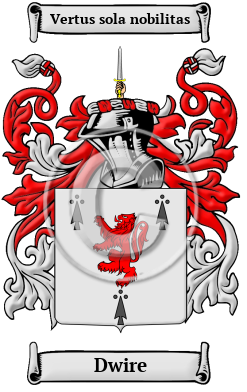
The motto was originally a war cry or slogan. Mottoes first began to be shown with arms in the 14th and 15th centuries, but were not in general use until the 17th century. Thus the oldest coats of arms generally do not include a motto. Mottoes seldom form part of the grant of arms: Under most heraldic authorities, a motto is an optional component of the coat of arms, and can be added to or changed at will; many families have chosen not to display a motto.
Motto: Vertus sola nobilitas
Motto Translation: Virtue alone enobles
- MacLysaght, Edward, The Surnames of Ireland. Ireland: Irish Academic Press, sixth edition, 1985. Print. (ISBN 0-7165-2366-3)
- Smith, Eldson Coles, New Dictionary of American Family Names New York: Harper & Row, 1956. Print
- Lower, Mark Anthony, Patronymica Britannica, A Dictionary of Family Names of the United Kingdom. London: John Russel Smith, 1860. Print.
- MacLysaght, Edward, Supplement to Irish Families. Baltimore: Genealogical Book Company, 1964. Print.
- Filby, P. William, Meyer, Mary K., Passenger and immigration lists index : a guide to published arrival records of about 500,000 passengers who came to the United States and Canada in the seventeenth, eighteenth, and nineteenth centuries. 1982-1985 Cumulated Supplements in Four Volumes Detroit, Mich. : Gale Research Co., 1985, Print (ISBN 0-8103-1795-8)
 |