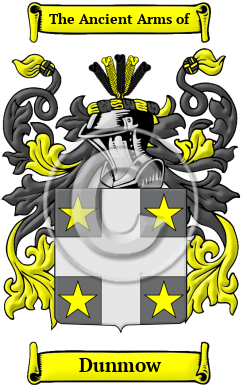
| ![Show Contents]() Dunmow History, Family Crest & Coats of Arms Dunmow History, Family Crest & Coats of Arms
- Origins Available:
England
Etymology of DunmowWhat does the name Dunmow mean? When the ancestors of the Dunmow family emigrated to England following the Norman Conquest in 1066 they brought their family name with them. They lived in Essex, at Great Dunmow or Little Dunmow. Great Dunmow "is supposed by Bishop Gibson to be the site of the Roman station Cæsaromagus, and this conjecture has been adopted by other antiquaries; coins have been discovered at several places near the town, and the road leading from it to Colchester, which was probably Camalodunum, displays some indications of Roman construction. At the time of the Norman survey it was the chief place in the hundred to which it gives name, and in 1250 it was made a market-town." 1 Little Dunmow "is celebrated for an ancient custom connected with the manor of Little Dunmow, of delivering a gammon, or flitch of bacon, on demand to any couple who, after having been married a year and a day, will swear that neither party has repented, and that no cause of quarrel or complaint has arisen between them. Before the Reformation the oath used to be administered, and the bacon given, by the prior of the convent; and since, the ceremony has been occasionally performed at a court Baron before the steward of the manor. The institution of the custom is supposed to have taken place soon after the Norman Conquest." 1 In the church of Little Dunmow, "is a monument with a female figure in alabaster, said to represent Matilda Fitz-Walter, famous in legendary story as the wife or mistress of Robin Hood, and the object of the illicit passion of King John, who is stated to have caused her to be poisoned, in revenge for having rejected his addresses." 1 Early Origins of the Dunmow familyThe surname Dunmow was first found in Essex where they held a family seat as Lords of the Manor of Dunmow. Originally, the Saxon spelling was Dommauua. 2 Conjecturally, the family name is descended from one of the holders of land identified by the Domesday Book Survey taken in 1086, as sharing estates at Dunmow. These were Adeluf de Marck from Count Eutace, the tenant in Chief, Wulfbert from Earl William Warren, Edmer from the Swain of Essex, Ralph from Eudo the Steward, Serlo from Hamo the Steward, Martel and William from Geoffrey de Mandeville. All these shared the estates of the villages Great Dunmow and Little Dunmow, and, genealogically speaking, it is difficult to identify which of these land holders at the taking of the Domesday Book 3 was the scion of the Dunmow family name. The villages, Little and Greater Dunmow, contained 3 Mills, 20 Beehives, 65 goats, 11 Cobs(work horses,) and 21 cattle, holdings which gave it a rating of being a fairly large and influential town by Domesday standards. Early rolls give a glimpse of the many spellings in use over the years: Ralph de Dunmauue was registered at Colchester, Essex in 1198; Richard de Dunmawe was registered in 1270; Roger de Dunmowe was registered in London in 1339; and John Dunmowe was listed in the Feet of Fines for Essex in 1374. 4 Early History of the Dunmow familyThis web page shows only a small excerpt of our Dunmow research. Another 80 words (6 lines of text) covering the year 1104 is included under the topic Early Dunmow History in all our PDF Extended History products and printed products wherever possible. Dunmow Spelling VariationsThe English language only became standardized in the last few centuries. For that reason, spelling variations are common among many Anglo-Norman names. The shape of the English language was frequently changed with the introduction of elements of Norman French, Latin, and other European languages; even the spelling of literate people's names were subsequently modified. Dunmow has been recorded under many different variations, including Dunmow, Dunmowe, Dunmough, Dunmo, Dunmole and many more. Early Notables of the Dunmow family Migration of the Dunmow familyTo escape the uncertainty of the political and religious uncertainty found in England, many English families boarded ships at great expense to sail for the colonies held by Britain. The passages were expensive, though, and the boats were unsafe, overcrowded, and ridden with disease. Those who were hardy and lucky enough to make the passage intact were rewarded with land, opportunity, and social environment less prone to religious and political persecution. Many of these families went on to be important contributors to the young nations of Canada and the United States where they settled. Dunmows were some of the first of the immigrants to arrive in North America: Francis Dunmole who landed in America in 1754.
| Contemporary Notables of the name Dunmow (post 1700) | + |
- Lewis, Samuel, A Topographical Dictionary of England. Institute of Historical Research, 1848, Print.
- Harrison, Henry, Surnames of the United Kingdom: A Concise Etymological Dictionary Baltimore: Geneological Publishing Company, 2013. Print
- Williams, Dr Ann. And G.H. Martin, Eds., Domesday Book A Complete Translation. London: Penguin, 1992. Print. (ISBN 0-141-00523-8)
- Reaney, P.H and R.M. Wilson, A Dictionary of English Surnames. London: Routledge, 1991. Print. (ISBN 0-415-05737-X)
 |