
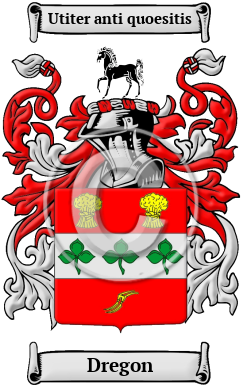
Show ContentsDregon History, Family Crest & Coats of Arms

Early Origins of the Dregon family

The surname Dregon was first found in Ayrshire (Gaelic: Siorrachd Inbhir Àir), formerly a county in the southwestern Strathclyde region of Scotland, that today makes up the Council Areas of South, East, and North Ayrshire, where they held a family seat on the English/Scottish border. After the Norman Conquest of England many of Duke William's rebellious Barons moved north. The border became a convenient but turbulent no-man's land where the persecuted Many were given land by King Malcolm Canmore and later by King David of Scotland. Some were native Scots. In the 16th century they became known as the 'unruly clans'. The name was first recorded in Scotland in the parish of Dreghorn near Colinton. This was the site of a former castle, but whether it belonged to Dreghorn 'of that ilk' cannot be ascertained at this time. The first of the name was William of Dregarn in Dreghorn.

Early History of the Dregon family

This web page shows only a small excerpt of our Dregon research. Another 70 words (5 lines of text) are included under the topic Early Dregon History in all our PDF Extended History products and printed products wherever possible.

Dregon Spelling Variations

Spelling variations of this family name include: Dreghorn, Dregarn, Dregorn, Dregon, Dregarne and others.

Early Notables of the Dregon family

More information is included under the topic Early Dregon Notables in all our PDF Extended History products and printed products wherever possible.

Migration of the Dregon family

Some of the first settlers of this family name or some of its variants were: John Dreghorn, who settled in America in 1815; Jean Dreghorn, who came to America in 1820; Robt Dreghorn, who came to Savannah, GA in 1822; Robert Dreghorn, who settled in Georgia in 1823.


The Dregon Motto +

The motto was originally a war cry or slogan. Mottoes first began to be shown with arms in the 14th and 15th centuries, but were not in general use until the 17th century. Thus the oldest coats of arms generally do not include a motto. Mottoes seldom form part of the grant of arms: Under most heraldic authorities, a motto is an optional component of the coat of arms, and can be added to or changed at will; many families have chosen not to display a motto.

Motto: Utiter anti quoesitis
Motto Translation: He uses what has been gained before.


Houseofnames.com on Facebook