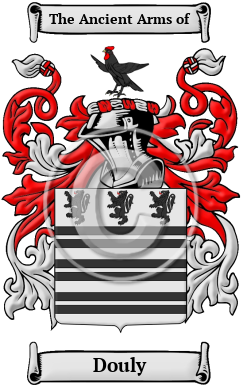
| ![Show Contents]() Douly History, Family Crest & Coats of Arms Douly History, Family Crest & Coats of Arms
Etymology of DoulyWhat does the name Douly mean? Of all the French names to come from Normandy, Douly is one of the most ancient. The name is a result of the original family having lived at a place in Normandy, called Ouilly-le-Basset in the arrondissement and canton of Falaise in Calvados. The name is adapted from the French word "oeil," meaning "eye," which was used metaphorically to refer to the source of a spring or fountain. 1 Early Origins of the Douly familyThe surname Douly was first found in Normandy (French: Normandie), the former Duchy of Normandy, where this distinguished family held a family seat in the honor of the seigneurie of Ouilly-le-Basset in the arrondissement and canton of Falaise in Calvados. Of this family Robert D'Ouilli, the son of Foque D'Aulnay, who was descended from D'Alnay, the first Duke of the Normans of Loire 895-905, joined Duke William of Normandy in the Conquest of England in 1066 A.D. He is referred to by Wace, the chronicler of the Battle of Hastings, as "E cil d'Ouillie," and received the castle of Wallingford in 1067 and possessed sixty-one manors with forty-two habitable houses in the county of Oxford of which he was the Constable. Wallingford was an ancient Roman castle and Robert D'Ouillie, at the command of William the Conqueror, rebuilt the castle in the Norman style, an impregnable edifice which would play a most significant part in history. He gave much of his estates to Roger D'Ivri, his sworn brother in Arms. This Robert also ceded to Roger his Barony of St. Valery. René Ouellet, born in 1642, son of François and Elisabeth (née Barre), was one of the first people found in Canada with the name Ouellet. René first married Anne Rivet on 8th March 1666 and he later married Thérèse Mignot on 6th February 1679. Throughout his two marriages René had six sons that carried on the family name of Ouellet. René was buried on 15th January 1722 in Sainte-Anne-de-la-Pocatière, Quebec. 2 Early History of the Douly familyThis web page shows only a small excerpt of our Douly research. Another 46 words (3 lines of text) covering the years 1066 and 1067 are included under the topic Early Douly History in all our PDF Extended History products and printed products wherever possible. Douly Spelling VariationsThe many different spellings of French surnames can be partially explained by the use of local dialects and by the influence of other languages during the early development of the French language. As a result of these linguistic and cultural influences, the name Douly is distinguished by a number of regional variations. The many spelling variations of the name include Oueilly, Oueilly, Ouilly, Ouele, Oueillade, Willet, Willett, Williot, Wille, Willette, Willi, Oulette, Ouellet, Oullett, Wellett, Oullette and many more. Early Notables of the Douly familyMore information is included under the topic Early Douly Notables in all our PDF Extended History products and printed products wherever possible.
| Douly migration to the United States | + |
By 1643 there were only about 300 people in Quebec. Since immigration was slow, early marriage was desperately encouraged amongst the immigrants. The fur trade attracted migrants, both noble and commoner. 15,000 explorers left Montreal in the late 17th and 18th centuries. By 1675, there were 7000 French in Quebec. By the same year the Acadian presence in Nova Scotia, New Brunswick and Prince Edward Island had reached 500. In 1755, 10,000 French Acadians refused to take an oath of allegiance to England and were deported to Louisiana. The French founded Lower Canada, thus becoming one of the two great founding nations of Canada. The distinguished family name Douly has made significant contributions to the culture, arts, sciences and religion of France and New France. Amongst the settlers in North America with this distinguished name Douly were
Douly Settlers in United States in the 19th Century- Daniel Douly, who landed in New York in 1820
- Thomas Douly, who immigrated to New York in 1852
- Dauzat, Albert, Morlet, Marie-Thérèse, Dictionaire Étymologique des Noms et Prénoms de France. Paris: Librairie Larousse, 1987. Print.
- Olivier, Reginald L. Your Ancient Canadian Family Ties. Logan: The Everton Publishers, Inc., P.O. Box 368, 1972. Print
 |