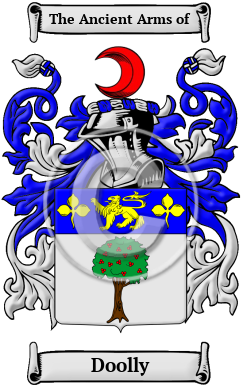
| ![Show Contents]() Doolly History, Family Crest & Coats of Arms Doolly History, Family Crest & Coats of Arms
- Origins Available:
Ireland
Etymology of DoollyWhat does the name Doolly mean? Throughout history, very few Irish surnames have exclusively maintained their original forms. Before being translated into English from Irish Gaelic, Doolly appeared as Ó Dobhailen or "Dubhshláin," which combines the Gaelic elements "Dubh," meaning dark, with "shláin," meaning challenge or defiance. 1 Early Origins of the Doolly familyThe surname Doolly was first found in Leinster, where they are believed to be descended from Eochaidh, King of Leinster, and became one of the "Seven septs of Leix." However, the name is "fairly common to-day in Ulster - in the Catholic areas of Counties Cavan and Fermanagh - and in the Counties of Roscommon and Galway in Connacht. In the census of 1659 the name appears principally in Counties Roscommon and Fermanagh." 2 Early History of the Doolly familyThis web page shows only a small excerpt of our Doolly research. Another 39 words (3 lines of text) covering the years 1172, 1834 and 1914 are included under the topic Early Doolly History in all our PDF Extended History products and printed products wherever possible. Doolly Spelling VariationsPronunciation, rather than spelling, guided scribes and church officials when recording names during the Middle Ages. This practice often resulted in one person's name being recorded under several different spellings. Numerous spelling variations of the surname Doolly are preserved in these old documents. The various spellings of the name that were found include Dolan, Doland, Dooley, Dowling, Doolin, Doolan, O'Dooley, O'Dolan, O'Doolin, Dollan, Dolland, Dooland, Dowlling, Doolley and many more. Early Notables of the Doolly familyMore information is included under the topic Early Doolly Notables in all our PDF Extended History products and printed products wherever possible. Migration of the Doolly familyThe 19th century saw a great wave of Irish families leaving Ireland for the distant shores of North America and Australia. These families often left their homeland hungry, penniless, and destitute due to the policies of England. Those Irish immigrants that survived the long sea passage initially settled on the eastern seaboard of the continent. Some, however, moved north to a then infant Canada as United Empire Loyalists after ironically serving with the English in the American War of Independence. Others that remained in America later joined the westward migration in search of land. The greatest influx of Irish immigrants, though, came to North America during the Great Potato Famine of the late 1840s. Thousands left Ireland at this time for North America, and those who arrived were immediately put to work building railroads, coal mines, bridges, and canals. In fact, the foundations of today's powerful nations of the United States and Canada were to a larger degree built by the Irish. Archival documents indicate that members of the Doolly family relocated to North American shores quite early: Jimmy, Michael, John, Patrick, and Thomas Dolans, Doolins, Dowlings, landed at Philadelphia in the 1800's and made their way to different railroad sites to make their fortune.
- MacLysaght, Edward, More Irish Families. Dublin: Irish Academic Press, 1982. Print. (ISBN 0-7165-0126-0)
- MacLysaght, Edward, Irish Families Their Names, Arms and Origins 4th Edition. Dublin: Irish Academic, 1982. Print. (ISBN 0-7165-2364-7)
 |