| ![Show Contents]() Dismukes History, Family Crest & Coats of Arms Dismukes History, Family Crest & Coats of Arms
- Origins Available:
England
Etymology of DismukesWhat does the name Dismukes mean? The name Dismukes reached English shores for the first time with the ancestors of the Dismukes family as they migrated following the Norman Conquest of 1066. The Dismukes family lived in Gloucestershire. The name is derived from the local of Dymock, a village in this county. Dymock was the home of the Dymock poets (1911 to 1914) that included Robert Frost, Lascelles Abercrombie, Rupert Brooke, Edward Thomas, Wilfrid Wilson Gibson, and John Drinkwater. The homes of Robert Frost and Wilfrid Wilson Gibson can still be seen there today. It is thought that the family first lived at Knight's Green, an area just outside of the village of Dymock. A reference in 1848 listed the village as having 1776 inhabitants, but today there are fewer than 300. 1 Early Origins of the Dismukes familyThe surname Dismukes was first found in Gloucestershire where the village and parish of Dymock dates back to before the Norman Conquest. According to the Domesday Book, Dymock was held by King Edward at that time and was part of the Botloe hundred. It goes on to mention that King William held it in demesne for 4 years and after that, Earl William held it followed by his son Roger. It was sizable as there was land there for 41 ploughs and a priest held another 12 acres at the time. 2 Today the village comprises over 7,000 acres. The name Dymock was possibly derived from the Celtic word "din" which meant "fort" 3 Another reference claims that name was derived from the Saxon words "dim" for dark, + "ac" for oak, in other words "dark oak." 1 Remains can still be seen of an ancient hall in Howell, Lincolnshire, the seat of the Dymoke family at one time. 1 One of the first on record was Roger Dymock (fl. 1395), an early English theologian who studied at Oxford, and there proceeded to the degree of doctor in divinity. 4 Sir John Dymoke (d. 1381), was the Kng's Champion, or Champion of England, "whose functions were confined to the performance of certain ceremonial duties at coronations, is stated to have been the son of John Dymoke, by his wife, Felicia Harevill. The family has been variously traced to the village of the name in Gloucestershire and to the Welsh borders near Herefordshire. The importance of Sir John and of his descendants was due to his marriage with Margaret (b. 1325), daughter of Thomas de Ludlow (b. 1300). " 4 Early History of the Dismukes familyThis web page shows only a small excerpt of our Dismukes research. Another 101 words (7 lines of text) covering the years 1350, 1381, 1406, 1428, 1469, 1471, 1500, 1531, 1546, 1566 and 1580 are included under the topic Early Dismukes History in all our PDF Extended History products and printed products wherever possible. Dismukes Spelling VariationsBefore English spelling was standardized a few hundred years ago, spelling variations of names were a common occurrence. Elements of Latin, Norman French and other languages became incorporated into English throughout the Middle Ages, and name spellings changed even among the literate. The variations of the surname Dismukes include Dymoke, Dymock, Dimock, Dimoke and others. Early Notables of the Dismukes familySir John Dymoke (died 1381), held the manor of Scrivelsby, Lincolnshire; Margaret Dymoke (ca.1500-?), of Scrivelsby, Lincolnshire, lady-in-waiting at the court of Henry VIII of England; Sir Edward Dymoke, of Scrivelsby, Lincolnshire (d. 1566), Hereditary King's Champion; Robert Dymoke, Dymock or Dymocke, of Scrivelsby, Lincolnshire (1531-1580), Queen's Champion of England; and Sir Thomas Dymoke (1428?-1471) who joined a Lancastrian rising in 1469, and was beheaded in 1471 by order of...
Another 69 words (5 lines of text) are included under the topic Early Dismukes Notables in all our PDF Extended History products and printed products wherever possible. Dismukes RankingIn the United States, the name Dismukes is the 13,807th most popular surname with an estimated 2,487 people with that name. 5 Migration of the Dismukes familyIn England at this time, the uncertainty of the political and religious environment of the time caused many families to board ships for distant British colonies in the hopes of finding land and opportunity, and escaping persecution. The voyages were expensive, crowded, and difficult, though, and many arrived in North America sick, starved, and destitute. Those who did make it, however, were greeted with greater opportunities and freedoms that they could have experienced at home. Many of those families went on to make important contributions to the young nations in which they settled. Early immigration records have shown some of the first Dismukess to arrive on North American shores: Thomas Dimmock who settled in Massachusetts in 1630; Martin Dimock settled in Virginia in 1637; William Dymocke arrived with his wife and servants in Barbados in 1679.
| Contemporary Notables of the name Dismukes (post 1700) | + |
- Reese Dismukes (b. 1992), American former NFL football center for the Pittsburgh Steelers (2015), Carolina Panthers (2015-2016) and the Denver Broncos (2016)
- Andrew Vincent Dismukes (b. 1995), is an American comedian, actor, and writer for the NBC sketch comedy series Saturday Night Live in 2017 and later joined the cast as a featured player in 2020
- R. E. Dismukes, American Democratic Party politician, Delegate to Democratic National Convention from Georgia, 1916 6
- John L. Dismukes, American Democratic Party politician, Delegate to Democratic National Convention from Kentucky, 1920 7
- G. V. Dismukes, American politician, Mayor of Prichard, Alabama, 1952-60 7
- E. P. Dismukes, American Democratic Party politician, Delegate to Democratic National Convention from Florida, 1884 7
- John Taylor Dismukes, American illustrator and artist who has developed posters, album covers and logos for Foreigner, The Grateful Dead, Steppenwolf, Charlotte's Web, Mad Max Beyond Thunderdome, Star Trek, Star Wars and many more
- William "Dizzy" Dismukes (1890-1961), American pitcher and manager in Negro League Baseball, active 1910 through 1942
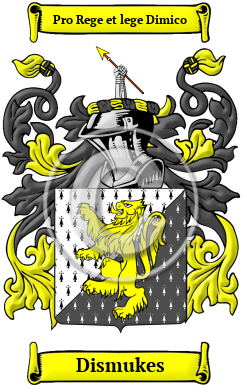
The motto was originally a war cry or slogan. Mottoes first began to be shown with arms in the 14th and 15th centuries, but were not in general use until the 17th century. Thus the oldest coats of arms generally do not include a motto. Mottoes seldom form part of the grant of arms: Under most heraldic authorities, a motto is an optional component of the coat of arms, and can be added to or changed at will; many families have chosen not to display a motto.
Motto: Pro Rege et lege Dimico
Motto Translation: Fight for King and Law.
- Lewis, Samuel, A Topographical Dictionary of England. Institute of Historical Research, 1848, Print.
- Williams, Dr Ann. And G.H. Martin, Eds., Domesday Book A Complete Translation. London: Penguin, 1992. Print. (ISBN 0-141-00523-8)
- Mills, A.D., Dictionary of English Place-Names. Oxford: Oxford University Press, 1991. Print. (ISBN 0-19-869156-4)
- Smith, George (ed), Dictionary of National Biography. London: Smith, Elder & Co., 1885-1900. Print
- "What are the 5,000 Most Common Last Names in the U.S.?". NameCensus.com, https://namecensus.com/last-names/
- The Political Graveyard: Alphabetical Name Index. (Retrieved 2016, January 25) . Retrieved from http://politicalgraveyard.com/alpha/index.html
 |