
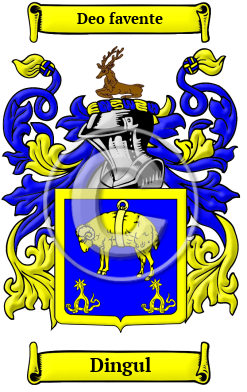
Show ContentsDingul History, Family Crest & Coats of Arms

Etymology of Dingul

What does the name Dingul mean?

In the Middle Ages, Viking immigrants settled the shores of Scotland and named many places. The Dingul name was then created from one of these place names. They lived at Royal Burgh of Dingwall, in Ross-shire, Scotland. The place-name is derived from the Old English word dingle, which meant valley or hollow. This is a habitation surname, derived from an already existing place-name.

Early Origins of the Dingul family

The surname Dingul was first found in Ross-shire (Gaelic: Siorrachd Rois) a former county, now part of the Council Areas of Highland and Western Isles in Northern Scotland, which emerged from the Gaelic lordship of the Earl of Ross, where John Yonger of Dyngvale witnessed a charter by William, Earl of Ross in 1342. Another charter by the same earl was witnessed by John called Yong and Thomas, his brother (c. 1350-72.) A few years later, William of Dyngwale was listed as dean of Aberdeen and Ross in 1389. Thomas of Dyngvale was listed as a canon in 1451. 1

Early History of the Dingul family

This web page shows only a small excerpt of our Dingul research. Another 134 words (10 lines of text) covering the years 1350, 1452 and 1538 are included under the topic Early Dingul History in all our PDF Extended History products and printed products wherever possible.

Dingul Spelling Variations

Intuition and sound were the primary sources medieval scribes used to judge appropriate spellings and translations for names. The spelling of a name thus varied according to who was doing the recording. The different spelling variations of Dingul include Dingwall, Dingwalls, Dingall, Dingell, Dingle, Dingill, Dingal, Dingel and many more.

Early Notables of the Dingul family

More information is included under the topic Early Dingul Notables in all our PDF Extended History products and printed products wherever possible.

Migration of the Dingul family

In their new home, Scots found land and opportunity, and some even fought for their new freedom in the American War of Independence. Some, who remained loyal to the crown went north to Canada as United Empire Loyalists. In this century, the ancestors of both of these groups have begun recovering their illustrious national heritage through Clan societies and other Scottish historical organizations. Early immigration and passenger lists indicate many people bearing the Dingul name: Donald Dingwall who was banished to Barbados in the year 1745. He was later transferred to the mainland.


The Dingul Motto +

The motto was originally a war cry or slogan. Mottoes first began to be shown with arms in the 14th and 15th centuries, but were not in general use until the 17th century. Thus the oldest coats of arms generally do not include a motto. Mottoes seldom form part of the grant of arms: Under most heraldic authorities, a motto is an optional component of the coat of arms, and can be added to or changed at will; many families have chosen not to display a motto.

Motto: Deo favente
Motto Translation: By the favour of God.


  1. Black, George F., The Surnames of Scotland Their Origin, Meaning and History. New York: New York Public Library, 1946. Print. (ISBN 0-87104-172-3)


Houseofnames.com on Facebook