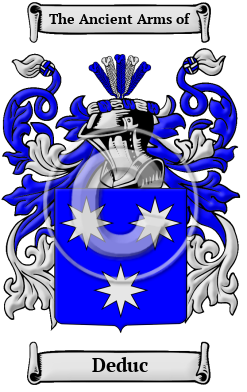
| ![Show Contents]() Deduc History, Family Crest & Coats of Arms Deduc History, Family Crest & Coats of Arms
- Origins Available:
France
Etymology of DeducWhat does the name Deduc mean? The surname Deduc is an ancient French name from Brittany. It was a name given to a person who was a person who put on the airs and graces of a Duke, or for a servant who worked in the household of a Duke. Early Origins of the Deduc familyThe surname Deduc was first found in Brittany where they held a family seat in the honor of the seigneurie of Blardais, Busnelaye, and Rouvray. By the 13th century they also branched to St. Sulspice in Normandy. Members of the Norman branch became seigneurs, and in this region they held a family seat at Duquerie. The family gradually, over the next three or four centuries, moved eastward to île-de-France, to Hainaut and finally to Flanders (Belgium). In the latter region they held a family seat at Masnuy-St.Pierre, and members of this branch became knights in 1735. In Flanders they were Barons in 1787, just before the revolution, and intermarried with the distinguished family of Miche. In île-de-France they held a family seat at Fontaine. They also acquired estates in Perche, Champagne, Marche, and Gascogne. Jean Leduc, born in 1624, travelled from Ingre, France to Canada in 1652. After arriving in Quebec he worked as a sawyer and he married Marie Soulinie, born in 1631, on 11th November 1652. The Lords of the Isle of Montreal gave Jean an acre of land on 20th August 1655 and this is where he settled with Marie. Jean and Marie had six children together, all boys, that all have many ancestors with the name Leduc in Canada. 1 Early History of the Deduc familyThis web page shows only a small excerpt of our Deduc research. The years 1742 and 1777 are included under the topic Early Deduc History in all our PDF Extended History products and printed products wherever possible. Deduc Spelling VariationsMost surnames have experienced slight spelling changes. A son may not chose to spell his name the same way that his father did. Many were errors, many deliberate. During the early development of the French language, a person usually gave his version, phonetically, to a scribe, a priest, or a recorder. Prefixes or suffixes varied. They were optional as they passed through the centuries, or were adopted by different branches to signify either a political or religious adherence. Hence, there a many spelling variations of the name Deduc, including Leduc, Laduc, le Duc, Le Du, Ledu, Le Duc, De Ducé and many more. Early Notables of the Deduc familyMore information is included under the topic Early Deduc Notables in all our PDF Extended History products and printed products wherever possible. Migration of the Deduc familyFrance finally gave land incentives for 2,000 migrants during the 1700s. Early marriage was encouraged in New France, and youths of 18 took fourteen-year-old girls for their wives. The fur trade was developed and attracted migrants, both noble and commoner from France. 15,000 explorers left Montreal in the late 17th and 18th centuries, leaving French names scattered across the continent. The search for the Northwest passage continued. Migration from France to New France or Quebec, as it was now more popularly called, continued until 1759. By 1675, there were 7000 French in Quebec. By the same year the Acadian presence in Nova Scotia, New Brunswick and Prince Edward Island had reached 500. In the treaty of Utrecht, the Acadians were ceded by France to Britain in 1713. In 1755, 10,000 French Acadians refused to take an oath of allegiance to England and were deported. They found refuge in Louisiana. Meanwhile, in Quebec, the French race flourished, founding in Lower Canada, one of the two great solitudes which became Canada. Many of this distinguished family name Deduc were prominent in social, cultural, religious and political affairs in France and New France. Amongst the settlers in North America with this distinguished name Deduc were Jean Leduc who arrived in Saint Omer, Quebec, from Perche on the southern border of Normandy in 1652; Antoine-Pierre Leduc arrived in Quebec from Normandy in 1681.
- Olivier, Reginald L. Your Ancient Canadian Family Ties. Logan: The Everton Publishers, Inc., P.O. Box 368, 1972. Print
 |