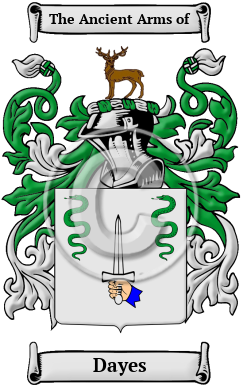
| ![Show Contents]() Dayes History, Family Crest & Coats of Arms Dayes History, Family Crest & Coats of Arms
- Origins Available:
Ireland
Etymology of DayesWhat does the name Dayes mean? All Irish surnames have a unique and often romantic meaning. The name Dayes originally appeared in Gaelic as Ó Deaghaidh or Ó Diaghaidh. 1 Early Origins of the Dayes familyThe surname Dayes was first found in County Clare (Irish: An Clár) located on the west coast of Ireland in the province of Munster, where O'Dea was chief of Dysart-O'Dea, now the parish of Dysart, barony of Inchiquin, one of the original chiefs and clans of ancient Thomond. Today Dysert O'Dea Castle still stands near Corofin, County Clare with its Romanesque Doorway and High Cross and was the site of the Battle of Dysert O'Dea in 1318. It was here that the Irish chieftain Conor O'Dea, chief of the Cineal Fearmaic and ally of Murtough O'Brien, stood his ground only to be defeated by the invading forces from Scotland. Early History of the Dayes familyThis web page shows only a small excerpt of our Dayes research. Another 137 words (10 lines of text) covering the years 1318 and 1434 are included under the topic Early Dayes History in all our PDF Extended History products and printed products wherever possible. Dayes Spelling VariationsNames during the Middle Ages were often recorded under several different spelling variations during the life of their bearers. Literacy was rare at that time and so how a person's name was recorded was decided by the individual scribe. Variations of the name Dayes include Day, Dea, O'Dea and others. Early Notables of the Dayes familyMost Rev. Thomas O'Dea; and Cornelius O'Dea (d. 1434), Archdeacon of Killaloe and later Bishop of Limerick. Three items of his have survived over the centuries: his Mitre, Crozier and a manuscript now entitled "The Black Book of Limerick." Today, they are all kept in Limerick's Hunt Museum. "According to a legend Bishop Cornelius O'Dea went to Dublin to attend a synod of bishops without his pontificals. Feeling the awkwardness of his position, he searched...
Another 74 words (5 lines of text) are included under the topic Early Dayes Notables in all our PDF Extended History products and printed products wherever possible.
| Dayes migration to the United States | + |
The English-ruled Ireland of the late 18th and 19th centuries featured a rapidly increasing population and an agricultural-based economy. This combination proved to be disastrous in the 1840s after a couple of failed potato harvests. Thousands died of disease and starvation, and thousands more left the country, often bound for North America. Those that survived the journey to North America were put to work building the bridges, canals, roadways, and railways needed for the development of an industrial society. Those Irish, although often despised by those already established in North American cities and towns, played an instrumental role in making Canada and the United States the powerful and wealthy nations that they are today. An examination of early immigration and passenger lists has shown many immigrants bearing the name Dayes:
Dayes Settlers in United States in the 17th Century- John Dayes, who landed in Maryland in 1668 2
| Dayes migration to West Indies | + |
The British first settled the British West Indies around 1604. They made many attempts but failed in some to establish settlements on the Islands including Saint Lucia and Grenada. By 1627 they had managed to establish settlements on St. Kitts (St. Christopher) and Barbados, but by 1641 the Spanish had moved in and destroyed some of these including those at Providence Island. The British continued to expand the settlements including setting the First Federation in the British West Indies by 1674; some of the islands include Barbados, Bermuda, Cayman Island, Turks and Caicos, Jamaica and Belize then known as British Honduras. By the 1960's many of the islands became independent after the West Indies Federation which existed from 1958 to 1962 failed due to internal political conflicts. After this a number of Eastern Caribbean islands formed a free association. 3Dayes Settlers in West Indies in the 17th Century- Mr. Thomas Dayes, (b. 1614), aged 20, British settler travelling from Gravesend, UK aboard the ship "Hopewell" arriving in Barbados on 17th February 1634 2
- MacLysaght, Edward, The Surnames of Ireland. Ireland: Irish Academic Press, sixth edition, 1985. Print. (ISBN 0-7165-2366-3)
- Filby, P. William, Meyer, Mary K., Passenger and immigration lists index : a guide to published arrival records of about 500,000 passengers who came to the United States and Canada in the seventeenth, eighteenth, and nineteenth centuries. 1982-1985 Cumulated Supplements in Four Volumes Detroit, Mich. : Gale Research Co., 1985, Print (ISBN 0-8103-1795-8)
- https://en.wikipedia.org/wiki/British_West_Indies
 |