| ![Show Contents]() Dansar History, Family Crest & Coats of Arms Dansar History, Family Crest & Coats of Arms
Etymology of DansarWhat does the name Dansar mean? The surname Dansar is a ancient Norman name that arrived in England after the Norman Conquest of 1066. Some instances of the surname are thought to have evolved from Middle English, Old French word "dance," meaning "dance;" and was an occupational name for a dancer or acrobat. 1 Some of this surname are thought to have evolved from the place name Ancere, in Normandy. 2 Early Origins of the Dansar familyThe surname Dansar was first found in the Hundredorum Rolls of 1273 which included: Hervey le Dansur, Norfolk; and Ralph Danser, Gloucestershire. 1 Over in Somerset, William le Dauncer was listed 1 Edward III (during the first year of the reign of Edward III.) 3 Early History of the Dansar familyThis web page shows only a small excerpt of our Dansar research. Another 64 words (5 lines of text) covering the years 1273, 1662, 1675, 1689, 1699, 1703, 1716, 1734, 1736, 1768, 1776, 1794, 1806, 1843, 1852, 1872 and 1933 are included under the topic Early Dansar History in all our PDF Extended History products and printed products wherever possible. Dansar Spelling VariationsIt is only in the last few hundred years that the English language has been standardized. For that reason, Anglo-Norman surnames like Dansar are characterized by many spelling variations. Scribes and monks in the Middle Ages spelled names they sounded, so it is common to find several variations that refer to a single person. As the English language changed and incorporated elements of other European languages such as Norman French and Latin, even literate people regularly changed the spelling of their names. The variations of the name Dansar include Dancer, Dansur, Danser, Dansar and others. Early Notables of the Dansar familyDaniel Dancer (1716-1794), the English miser, born at Pinner in 1716. "His grandfather and father were both noted in their time as misers, and are only less known to fame because their accumulation of wealth was not so great. The elder Dancer died in 1736, and Daniel, as the eldest of his four children, succeeded to his estate, which consisted of eighty acres of rich meadow land and of an adjoining farm called Waldos. Hitherto Dancer had given no manifestation of his miserly instincts, but now, in company with his only sister, who shared his tastes...
Another 95 words (7 lines of text) are included under the topic Early Dansar Notables in all our PDF Extended History products and printed products wherever possible. Migration of the Dansar family to IrelandSome of the Dansar family moved to Ireland, but this topic is not covered in this excerpt.
Another 124 words (9 lines of text) about their life in Ireland is included in all our PDF Extended History products and printed products wherever possible. Migration of the Dansar familyFaced with the chaos present in England at that time, many English families looked towards the open frontiers of the New World with its opportunities to escape oppression and starvation. People migrated to North America, as well as Australia and Ireland in droves, paying exorbitant rates for passages in cramped, unsafe ships. Many of the settlers did not make the long passage alive, but those who did see the shores of North America were welcomed with great opportunity. Many of the families that came from England went on to make essential contributions to the emerging nations of Canada and the United States. Some of the first immigrants to cross the Atlantic and come to North America carried the name Dansar, or a variant listed above: Thomas Dancer, who arrived in Barbados in 1671; John Dancer, who came to Virginia in 1731; Brill Dancer who settled in Maryland in 1775; and William Dancer, who settled in Maryland in 1774..
The motto was originally a war cry or slogan. Mottoes first began to be shown with arms in the 14th and 15th centuries, but were not in general use until the 17th century. Thus the oldest coats of arms generally do not include a motto. Mottoes seldom form part of the grant of arms: Under most heraldic authorities, a motto is an optional component of the coat of arms, and can be added to or changed at will; many families have chosen not to display a motto.
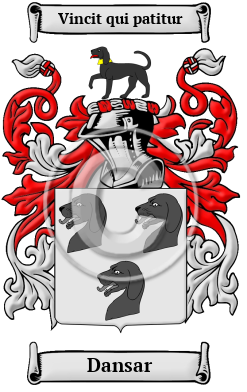
Motto: Vincit qui patitur
Motto Translation: He conquers who endures.
- Bardsley, C.W, A Dictionary of English and Welsh Surnames: With Special American Instances. Wiltshire: Heraldry Today, 1901. Print. (ISBN 0-900455-44-6)
- The Norman People and Their Existing Descendants in the British Dominions and the United States Of America. Baltimore: Genealogical Publishing, 1975. Print. (ISBN 0-8063-0636-X)
- Dickinson, F.H., Kirby's Quest for Somerset of 16th of Edward the 3rd London: Harrison and Sons, Printers in Ordinary to Her Majesty, St, Martin's Lane, 1889. Print.
 |