
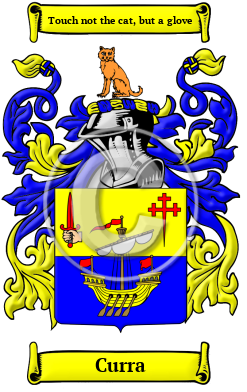
Show ContentsCurra History, Family Crest & Coats of Arms

Etymology of Curra

What does the name Curra mean?

The origin of the name Curra is uncertain. It may be a toponymic name derived from one of the places in Ireland called Curragh, the most famous of which is the Curragh of Kildare. The Gaelic word "curach" meaning "champion" or "hero" could also have been the origin of the name. Finally, in some cases, the name is of Scottish origin and is the Irish form of MacCurrach, a sept of the MacPherson clan.

Early Origins of the Curra family

The surname Curra was first found in the southern part of County Down, and the northern part of Louth, where Thomas Curragh, a farmer of Kilpatrick, was recorded in 1428 in a case in Archbishop Swayne's register. In the following century the name was found in and near Dublin. Richard Curragh was a farmer of Raheny in 1561, and another Richard Curragh was a member of the Merchant Tailor's Guild, and was made a freeman of Dublin city in 1589. The Curragh of Kildare is an expanse of plains land, famed for horse riding and races, that has been used for military purposes since antiquity.

Early History of the Curra family

This web page shows only a small excerpt of our Curra research. More information is included under the topic Early Curra History in all our PDF Extended History products and printed products wherever possible.

Curra Spelling Variations

Spelling variations of this family name include: Curragh, Curra, Currah and others.

Early Notables of the Curra family

  • the Curragh family of Dublin


Curra migration to the United States +


Curra Settlers in United States in the 19th Century
  • Joseph Curra and his family, who arrived in New York in 1867
  • Miss Delphine Curra, aged 23, German settler who arrived in New York in 1893 aboard the ship "Werkendam" 1

Curra migration to Australia +

Curra Settlers in Australia in the 19th Century
  • Miss Catherine Curra, (b. 1843), aged 20, Cornish housemaid departing from Soton on 5th May 1863 aboard the ship "Caduceus" arriving in Melbourne, Victoria, Australia on 1st July 1863 2


The Curra Motto +

The motto was originally a war cry or slogan. Mottoes first began to be shown with arms in the 14th and 15th centuries, but were not in general use until the 17th century. Thus the oldest coats of arms generally do not include a motto. Mottoes seldom form part of the grant of arms: Under most heraldic authorities, a motto is an optional component of the coat of arms, and can be added to or changed at will; many families have chosen not to display a motto.

Motto: Touch not the cat, but a glove


  1. Germans to America retrieved 21st October 2021. Retrieved from Glazier, Ira. A., and Filby, P. William. Germans to America: Lists of Passengers Arriving at U.S. Ports. Vol. 62, Scholarly Resources Inc, 2138
  2. Cornwall Online Parish Clerks. (Retrieved 3rd May 2018). Retrieved from http://www.opc-cornwall.org/Resc/pdfs/emigration_australia_victoria.pdf


Houseofnames.com on Facebook