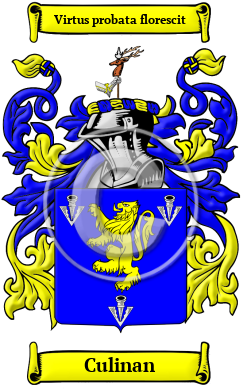
While the Anglicized versions of Irish names are familiar to most people, all Irish names have a long and proud Gaelic heritage that is often unknown. The original Gaelic form of the name Culinan is "O Cuileagain."
Loading...
Early Origins of the Culinan family
The surname Culinan was first found in County Londonderry (Irish: Doire), a Northern Irish county also known as Derry, in the province of Ulster, where they held a family seat from ancient times.
Early History of the Culinan family
This web page shows only a small excerpt of our Culinan research. Another 112 words (8 lines of text) are included under the topic Early Culinan History in all our PDF Extended History products and printed products wherever possible.
Culinan Spelling Variations
Individual scribes in the Ireland during the Middle Ages would often record a person's name various ways. How the name was recorded depended on what that particular scribe believed the proper spelling for the name pronounced to him was. Spelling variations revealed in the search for the origin of the Culinan family name include Culligan, Colligan, Quilligan, O'Quilligan, O'Culligan, O'Colligan, Coligan, Culigan, Colgan and many more.
Early Notables of the Culinan family
More information is included under the topic Early Culinan Notables in all our PDF Extended History products and printed products wherever possible.
Loading...
Loading...
Loading...
Loading...
Migration of the Culinan family
The 19th century saw a great wave of Irish migrating out of their homeland in a great measure due to the oppressive imperial policies of the English government and landowners. Many of these Irish families sailed to North America aboard overcrowded passenger ships. By far, the largest influx of Irish immigrants to North America occurred with Great Potato Famine during the late 1840s. These particular immigrants were instrumental in creation of the United States and Canada as major industrial nations because the many essential elements such as the roadways, canals, bridges, and railways required an enormous quantity of cheap labor, which these poor immigrants provided. Later generations of Irish in these countries also went on to make valuable contributions in such fields as the arts, commerce, politics, and education. Extensive research into immigration and passenger lists has revealed many early immigrants bearing the name Culinan: Arthur, Bernard, and Thomas Colligan, who arrived in Philadelphia between 1640 to 1670; as well as John, Pat and Simon Culligan, who arrived in Quebec in 1839..
The motto was originally a war cry or slogan. Mottoes first began to be shown with arms in the 14th and 15th centuries, but were not in general use until the 17th century. Thus the oldest coats of arms generally do not include a motto. Mottoes seldom form part of the grant of arms: Under most heraldic authorities, a motto is an optional component of the coat of arms, and can be added to or changed at will; many families have chosen not to display a motto.