| ![Show Contents]() Cukson History, Family Crest & Coats of Arms Cukson History, Family Crest & Coats of Arms
- Origins Available:
England
Etymology of CuksonWhat does the name Cukson mean? The name Cukson is part of the ancient legacy of the Anglo-Saxon tribes of Britain. Cukson was a name used for a son of a cook. 1 Further research revealed that the name is derived from the Norman French word cok, which means cook. "One of the few instances of the addition of the termination son to a profession or employment." 2 Early Origins of the Cukson familyThe surname Cukson was first found in the West Riding of Yorkshire where they were originally from Settle. 3 While there is no doubt that this is the area that the family anciently hailed from, we must look to Suffolk for the first record of the family in ancient rolls. The Curia Regis Rolls of 1208 include an entry for Hugo filius Coci. Over the ages, the "filius" name often became the suffix "son" when the use of Latin in surnames became less popular. 1 A few years later, the Assize Rolls for Northumberland included an entry for Gilbert le Fiz Kew, Fiz le Keu in 1279. and much later, Agnes Cukeson was listed in Yorkshire in 1511. 1 Early History of the Cukson familyThis web page shows only a small excerpt of our Cukson research. Another 120 words (9 lines of text) covering the years 1220, 1273, 1379, 1609, 1636, 1654, 1677, 1679, 1682, 1704, 1735 and 1743 are included under the topic Early Cukson History in all our PDF Extended History products and printed products wherever possible. Cukson Spelling VariationsUntil the dictionary, an invention of only the last few hundred years, the English language lacked any comprehensive system of spelling rules. Consequently, spelling variations in names are frequently found in early Anglo-Saxon and later Anglo-Norman documents. One person's name was often spelled several different ways over a lifetime. The recorded variations of Cukson include Cookson, Cuckson, Cockson, Coxon and others. Early Notables of the Cukson familyThomas Cookson or Coxon (fl. 1609-1636), one of the earliest English engravers, who left a large number of portraits engraved in a dry, but neatly finished manner. 4
Another Thomas Coxon (1654-1735), was an English Jesuit, a native of the county of Durham. 4
Captain John Coxon (fl. 1677-1682), was a buccaneer, one of the most famous...
Another 54 words (4 lines of text) are included under the topic Early Cukson Notables in all our PDF Extended History products and printed products wherever possible. Migration of the Cukson familyThousands of English families boarded ships sailing to the New World in the hope of escaping the unrest found in England at this time. Although the search for opportunity and freedom from persecution abroad took the lives of many because of the cramped conditions and unsanitary nature of the vessels, the opportunity perceived in the growing colonies of North America beckoned. Many of the settlers who survived the journey went on to make important contributions to the transplanted cultures of their adopted countries. The Cukson were among these contributors, for they have been located in early North American records: John Cookson who settled in Virginia in 1774; Craven Cookson settled in America in 1830; Thomas Coxson settled in St. Christopher in 1635; Thomas Coxson settled in Virginia in 1637.
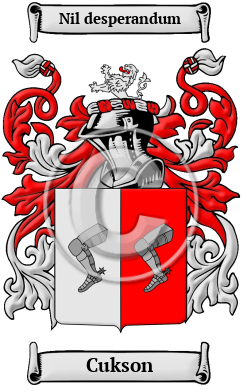
The motto was originally a war cry or slogan. Mottoes first began to be shown with arms in the 14th and 15th centuries, but were not in general use until the 17th century. Thus the oldest coats of arms generally do not include a motto. Mottoes seldom form part of the grant of arms: Under most heraldic authorities, a motto is an optional component of the coat of arms, and can be added to or changed at will; many families have chosen not to display a motto.
Motto: Nil desperandum
Motto Translation: Never despairing.
- Reaney, P.H and R.M. Wilson, A Dictionary of English Surnames. London: Routledge, 1991. Print. (ISBN 0-415-05737-X)
- Lower, Mark Anthony, Patronymica Britannica, A Dictionary of Family Names of the United Kingdom. London: John Russel Smith, 1860. Print.
- Arthur, William , An Etymological Dictionary of Family and Christian Names. London: 1857. Print
- Smith, George (ed), Dictionary of National Biography. London: Smith, Elder & Co., 1885-1900. Print
 |