| ![Show Contents]() Crumb History, Family Crest & Coats of Arms Crumb History, Family Crest & Coats of Arms
Etymology of CrumbWhat does the name Crumb mean? The rugged west coast of Scotland and the desolate Hebrides islands are thought to be the ancestral home of the ancestors of the Crumb family name. The Crumb surname is thought to be derived from the place named Crombie in the parish of Aucterless in the former county of Aberdeenshire. Crombie comes from the Gaelic "crom," which means "crooked." However, in some instances, bearers of this name are no doubt descended from Macilchrum. 1 Early Origins of the Crumb familyThe surname Crumb was first found in several areas of Scotland. The lands of Crummy, which belonged to the Abbey of Culross, Fifeshire, were built on land gifted by Malcolm, 7th Earl of Fife, in 1217. A John Crumme is on record in 1532, when he was excommunicated under letters of the Official of Lothian. Patrick Crummy of Carriden was keeper of the havens of Carriden in 1565. 1 Early History of the Crumb familyThis web page shows only a small excerpt of our Crumb research. Another 161 words (12 lines of text) covering the years 1450, 1477, 1503, 1516, 1541, 1600, 1653, 1677, 1786 and 1868 are included under the topic Early Crumb History in all our PDF Extended History products and printed products wherever possible. Crumb Spelling VariationsSpelling variations of this family name include: Crum, Crumme, Crumb, Crummy, Crumney, Crommie, Cromby, Macilchrum, Mcilchrum, McCrum, McIChrilcrumie, McCrumie and many more. Early Notables of the Crumb familyMore information is included under the topic Early Crumb Notables in all our PDF Extended History products and printed products wherever possible. Crumb RankingIn the United States, the name Crumb is the 8,147th most popular surname with an estimated 2,487 people with that name. 2 Migration of the Crumb family to IrelandSome of the Crumb family moved to Ireland, but this topic is not covered in this excerpt.
Another 60 words (4 lines of text) about their life in Ireland is included in all our PDF Extended History products and printed products wherever possible.
| Crumb migration to Canada | + |
Crumb Settlers in Canada in the 18th Century- Mr. Benjamin Crumb U.E. who settled in Canada c. 1783 3
- Mr. Benoni Crumb U.E. (b. 1760) born in Deerpark Township, Orange County, New York, USA who settled in Home District, Louth Township, Lincoln County, Ontario c. 1783 he served in the Indian Department and Butler's Rangers Regiment, married to Sarah Vollick in 1787 they had 7 children he died in 1816 3
- Mr. William Crumb U.E. who settled in Home District, [Niagara], Lincoln County, Ontario c. 1783 3
| Contemporary Notables of the name Crumb (post 1700) | + |
- George Henry Crumb (1929-2022), American composer of modern classical and avant-garde music from Charleston, West Virginia, best known for Ancient Voices of Children (1970), Black Angels (1971), and Makrokosmos III (1974).
- Wallace Raymond Crumb (1896-1973), American Republican politician, Mayor of Bristol, Connecticut, 1929-31; Alternate Delegate to Republican National Convention from Connecticut, 1936 4
- Wallace Bruce Crumb (1858-1938), American Democratic Party politician, Member of Connecticut State House of Representatives from Bristol, 1919-20; Defeated, 1920, 1922 5
- Leverett F. Crumb, American Republican politician, Westchester County Clerk, 1899; Alternate Delegate to Republican National Convention from New York, 1916 5
- Alexander G. Crumb, American Republican politician, Presidential Elector for Rhode Island, 1900; Delegate to Republican National Convention from Rhode Island, 1908 5
- Charles Vincent Crumb Jr. (1942-1993), American artist, brother of Robert Crumb
- David Crumb (b. 1962), American contemporary composer, son of composer George Crumb
- Ann Crumb, American Tony award nominated actress and singer, daughter of composer George Crumb
- Robert Crumb (b. 1943), American comic book artist, creator of "Fritz the Cat"
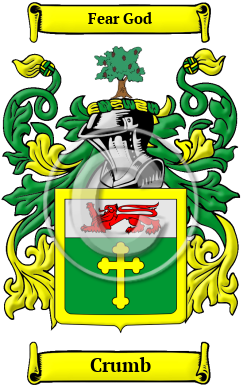
The motto was originally a war cry or slogan. Mottoes first began to be shown with arms in the 14th and 15th centuries, but were not in general use until the 17th century. Thus the oldest coats of arms generally do not include a motto. Mottoes seldom form part of the grant of arms: Under most heraldic authorities, a motto is an optional component of the coat of arms, and can be added to or changed at will; many families have chosen not to display a motto.
Motto: Fear God
- Black, George F., The Surnames of Scotland Their Origin, Meaning and History. New York: New York Public Library, 1946. Print. (ISBN 0-87104-172-3)
- "What are the 5,000 Most Common Last Names in the U.S.?". NameCensus.com, https://namecensus.com/last-names/
- Rubincam, Milton. The Old United Empire Loyalists List. Genealogical Publishing Co., Inc, 1976. (Originally published as; United Empire Loyalists. The Centennial of the Settlement of Upper Canada. Rose Publishing Company, 1885.) ISBN 0-8063-0331-X
- The Political Graveyard: Alphabetical Name Index. (Retrieved 2015, November 2) . Retrieved from http://politicalgraveyard.com/alpha/index.html
 |