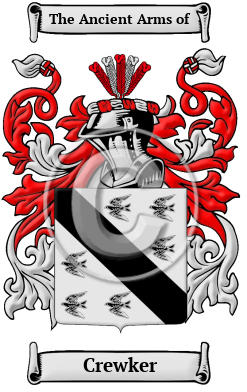
| ![Show Contents]() Crewker History, Family Crest & Coats of Arms Crewker History, Family Crest & Coats of Arms
- Origins Available:
England
Etymology of CrewkerWhat does the name Crewker mean? The name Crewker reached English shores for the first time with the ancestors of the Crewker family as they migrated following the Norman Conquest of 1066. The Crewker family lived in Suffolk. The family was originally from Crevecoeur, Normandy, and it is from this location that the name derives. Early Origins of the Crewker familyThe surname Crewker was first found in Kent where they held a family seat as Lords of the Manor. After the Battle of Hastings in 1066, William, Duke of Normandy, having prevailed over King Harold, granted most of Britain to his many victorious Barons. It was not uncommon to find a Baron, or a Bishop, with 60 or more Lordships scattered throughout the country. These he gave to his sons, nephews and other junior lines of his family and they became known as under-tenants. They adopted the Norman system of surnames which identified the under-tenant with his holdings so as to distinguish him from the senior stem of the family. After many rebellious wars between his Barons, Duke William, commissioned a census of all England to determine in 1086, settling once and for all, who held which land. He called the census the Domesday Book, 1 indicating that those holders registered would hold the land until the end of time. Hence, Hamon, Sire of Crevecoeur was Duke William's historian. He and his brother were at the Battle of Hastings. William appointed Hamon, Sheriff of Kent. He has two sons, the eldest, Robert FitzHamon became the founder of Tewksbury, and the youngest was Hamon, who was the ancestor of this great baronial family of which we report. One of Hamon's descendents, another Hamon, married Maud d'Avranches, the great Folkstone heiress, in the time of King Richard I of England. For more extensive reading, "The Falaise Roll" by Crispin and Macary, Genealogical Publishing, Baltimore is recommended. Early History of the Crewker familyThis web page shows only a small excerpt of our Crewker research. Another 83 words (6 lines of text) covering the years 1158, 1195, 1200, 1212, 1273 and 1284 are included under the topic Early Crewker History in all our PDF Extended History products and printed products wherever possible. Crewker Spelling VariationsAnglo-Norman names tend to be marked by an enormous number of spelling variations. This is largely due to the fact that Old and Middle English lacked any spelling rules when Norman French was introduced in the 11th century. The languages of the English courts at that time were French and Latin. These various languages mixed quite freely in the evolving social milieu. The final element of this mix is that medieval scribes spelled words according to their sounds rather than any definite rules, so a name was often spelled in as many different ways as the number of documents it appeared in. The name was spelled Crawcour, Creuequor, Croueqoer, Creuker, Crewquer, Craker, Crigor, Crevequer, Crevequere, Crevcure, Crevequre, Crevecoeur, Creegor, Cregor, Crewker, Crouequoer, Crevequer, Crequer and many more. Early Notables of the Crewker familyMore information is included under the topic Early Crewker Notables in all our PDF Extended History products and printed products wherever possible. Migration of the Crewker familyBecause of the political and religious discontent in England, families began to migrate abroad in enormous numbers. Faced with persecution and starvation at home, the open frontiers and generally less oppressive social environment of the New World seemed tantalizing indeed to many English people. The trip was difficult, and not all made it unscathed, but many of those who did get to Canada and the United States made important contributions to the young nations in which they settled. Some of the first North American settlers with Crewker name or one of its variants: Wm. Craker, who arrived in New York in 1832; William Craker, who settled in Pennsylvania in 1832; Levy Craker, who settled in New York in 1832; Levi Craker, who came to Pennsylvania in 1832.
- Williams, Dr Ann. And G.H. Martin, Eds., Domesday Book A Complete Translation. London: Penguin, 1992. Print. (ISBN 0-141-00523-8)
 |