| ![Show Contents]() Copinger History, Family Crest & Coats of Arms Copinger History, Family Crest & Coats of Arms
Early Origins of the Copinger familyThe surname Copinger was first found in County Cork (Irish: Corcaigh) the ancient Kingdom of Deis Muin (Desmond), located on the southwest coast of Ireland in the province of Munster, where they are thought to have come originally from Denmark, perhaps as early as the 10th century. Early History of the Copinger familyThis web page shows only a small excerpt of our Copinger research. Another 185 words (13 lines of text) covering the years 1301, 1319, 1422, 1461, 1634, 1636, 1638, 1639, 1642, 1753, 1794, 1808, 1830 and 1893 are included under the topic Early Copinger History in all our PDF Extended History products and printed products wherever possible. Copinger Spelling VariationsSpelling variations of this family name include: Coppinger, Coppenger, Copenger, Copinger, Coppynger, Copinsher, Coppinsher and many more. Early Notables of the Copinger family- Dominick Copinger, who was a member of the Irish Parliament from the city of Cork in 1634
- Stephen Copinger (b. 1794), a lawyer in Ireland, who graduated from Trinity College, Dublin
- Lieutenant-Colonel Henry Copinger (1808-1893), soldier in the 16th Regiment and a writer. There are legends of a so called "Cruel Coppinger," said to have been a giant of a man from Denmark, shipwreck...
Migration of the Copinger family to IrelandSome of the Copinger family moved to Ireland, but this topic is not covered in this excerpt. More information about their life in Ireland is included in all our PDF Extended History products and printed products wherever possible.
| Copinger migration to the United States | + |
Copinger Settlers in United States in the 19th Century- James Copinger, who arrived in Philadelphia in 1808
- Patt Copinger, who settled in Pennsylvania in 1865
| Contemporary Notables of the name Copinger (post 1700) | + |
- Walter Arthur Copinger (1847-1910), lawyer, historian, antiquary, who was Lord of the Manor of Buxhall, Suffolk
The motto was originally a war cry or slogan. Mottoes first began to be shown with arms in the 14th and 15th centuries, but were not in general use until the 17th century. Thus the oldest coats of arms generally do not include a motto. Mottoes seldom form part of the grant of arms: Under most heraldic authorities, a motto is an optional component of the coat of arms, and can be added to or changed at will; many families have chosen not to display a motto.
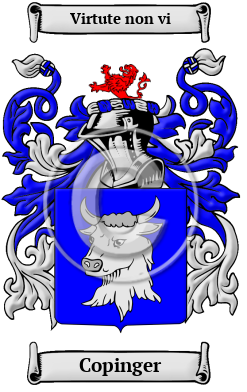
Motto: Virtute non vi
Motto Translation: By virtue not by force.
 |