
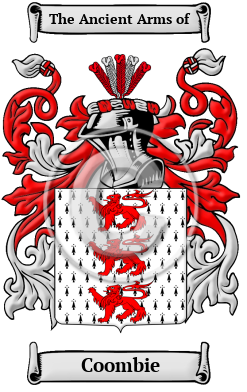
Show ContentsCoombie History, Family Crest & Coats of Arms

Etymology of Coombie

What does the name Coombie mean?

The present generation of the Coombie family is only the most recent to bear a name that dates back to the ancient Anglo-Saxon culture of Britain. Their name comes from having lived in a small valley; the surname Coombie is often derived from the Old English word cumb, which means valley. In this case, it belongs to the class of topographic surnames, which were given to people who resided near physical features such as hills, streams, churches, or types of trees. Alternately, the surname Coombie may be derived from residence in one of the many places called Comb, Combe, or Coombe. In this case, it belongs to the large category of Anglo-Saxon habitation names, which are derived from pre-existing names for towns, villages, parishes, or farmsteads.

Early Origins of the Coombie family

The surname Coombie was first found in Sussex where they held a family seat from very ancient times.

Early History of the Coombie family

This web page shows only a small excerpt of our Coombie research. Another 82 words (6 lines of text) covering the years 1269, 1317 and 1651 are included under the topic Early Coombie History in all our PDF Extended History products and printed products wherever possible.

Coombie Spelling Variations

Until the dictionary, an invention of only the last few hundred years, the English language lacked any comprehensive system of spelling rules. Consequently, spelling variations in names are frequently found in early Anglo-Saxon and later Anglo-Norman documents. One person's name was often spelled several different ways over a lifetime. The recorded variations of Coombie include Coombes, Cumbey, Cumbie, Coomes, Combes, Comes, Cumbay, Cumby, Coomby, Coombey and many more.

Early Notables of the Coombie family

More information is included under the topic Early Coombie Notables in all our PDF Extended History products and printed products wherever possible.

Migration of the Coombie family

Thousands of English families boarded ships sailing to the New World in the hope of escaping the unrest found in England at this time. Although the search for opportunity and freedom from persecution abroad took the lives of many because of the cramped conditions and unsanitary nature of the vessels, the opportunity perceived in the growing colonies of North America beckoned. Many of the settlers who survived the journey went on to make important contributions to the transplanted cultures of their adopted countries. The Coombie were among these contributors, for they have been located in early North American records: Anthony Coombe who settled there around the year 1640. He was a blacksmith by trade. According to tradition Anthony's parents wanted him to become a monk and gave him to a group of priests. He escaped later with an English Bible, and became a blacksmith in the town of Wells, where he defended his farm against the Indians. Henry Coombs bought land on Georgetown Island in 1676.


Houseofnames.com on Facebook
