
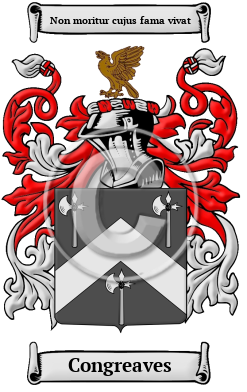
Show ContentsCongreaves History, Family Crest & Coats of Arms

Etymology of Congreaves

What does the name Congreaves mean?

The name Congreaves is of Anglo-Saxon origin and came from when the family lived near a lane cut through woods or forest. The name is derived from congreave, a Old English word for such a road.

Early Origins of the Congreaves family

The surname Congreaves was first found in Staffordshire at Congreve, "where the ancestors of this house were seated soon after the Conquest." 1 Congreve is now part of Penkridge, a market town and civil parish as of 1934.

Early History of the Congreaves family

This web page shows only a small excerpt of our Congreaves research. Another 140 words (10 lines of text) covering the years 1669, 1670 and 1729 are included under the topic Early Congreaves History in all our PDF Extended History products and printed products wherever possible.

Congreaves Spelling Variations

It is only in the last few hundred years that the English language has been standardized. For that reason, early Anglo-Saxon surnames like Congreaves are characterized by many spelling variations. As the English language changed and incorporated elements of other European languages, even literate people changed the spelling of their names. Scribes and monks in the Middle Ages spelled names they sounded, so it is common to find several variations that refer to a single person. The variations of the name Congreaves include: Congreve, Congrave and others.

Early Notables of the Congreaves family

William Congreve (1670-1729), and English dramatist and poet. He was "born at Bardsey, near Leeds, where he was baptised on 10 Feb. 1669. He was the son Congreve; his mother's maiden name Browning. His grandfather, Richard Congreve, was a cavalier named for the order of the Royal Oak. The family had...
Another 51 words (4 lines of text) are included under the topic Early Congreaves Notables in all our PDF Extended History products and printed products wherever possible.

Migration of the Congreaves family to Ireland

Some of the Congreaves family moved to Ireland, but this topic is not covered in this excerpt. More information about their life in Ireland is included in all our PDF Extended History products and printed products wherever possible.

Migration of the Congreaves family

Many English families tired of political and religious strife left Britain for the new colonies in North America. Although the trip itself offered no relief - conditions on the ships were extremely cramped, and many travelers arrived diseased, starving, and destitute - these immigrants believed the opportunities that awaited them were worth the risks. Once in the colonies, many of the families did indeed prosper and, in turn, made significant contributions to the culture and economies of the growing colonies. An inquiry into the early roots of North American families has revealed a number of immigrants bearing the name Congreaves or a variant listed above: John Congrave and Winifred settled in Virginia in 1635.


The Congreaves Motto +

The motto was originally a war cry or slogan. Mottoes first began to be shown with arms in the 14th and 15th centuries, but were not in general use until the 17th century. Thus the oldest coats of arms generally do not include a motto. Mottoes seldom form part of the grant of arms: Under most heraldic authorities, a motto is an optional component of the coat of arms, and can be added to or changed at will; many families have chosen not to display a motto.

Motto: Non moritur cujus fama vivat
Motto Translation: He does not die whose fame may survive.


  1. Shirley, Evelyn Philip, The Noble and Gentle Men of England; The Arms and Descents. Westminster: John Bower Nichols and Sons, 1866, Print.


Houseofnames.com on Facebook