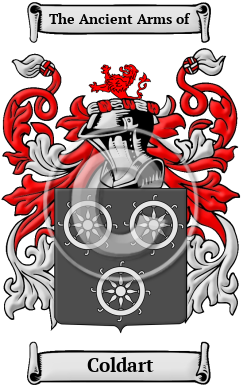
| ![Show Contents]() Coldart History, Family Crest & Coats of Arms Coldart History, Family Crest & Coats of Arms
- Origins Available:
Scotland
Early Origins of the Coldart familyThe surname Coldart was first found in Galloway (Gaelic: Gall-ghaidhealaibh), an area of southwestern Scotland, now part of the Council Area of Dumfries and Galloway, that formerly consisted of the counties of Wigtown (West Galloway) and Kirkcudbright (East Galloway.) "Explained as from Coltard-Colt herd, Old English colt + hierde. Of the Coultharts of Galloway a ridiculous genealogy has been published, in which the family are traced to one Coulthartus, a Roman soldier who fought in the battle of Mons Graupius." 1 We prefer to say that this legendary origin is in question and while the phonetic comparison is undeniable, we concur that this origin of the name is quite dubious. One source claims the name was actually an occupational name as in 'the coltherd' 2 and another claims the name is from Coudhart, a village in the department of Orne, of Argentan in Normandy. 3 Early History of the Coldart familyThis web page shows only a small excerpt of our Coldart research. Another 122 words (9 lines of text) covering the years 1467, 1530, 1602, 1619, 1627, 1657, 1663, 1666, 1684, 1686 and 1687 are included under the topic Early Coldart History in all our PDF Extended History products and printed products wherever possible. Coldart Spelling VariationsScribes in Medieval Scotland spelled names by sound rather than any set of rules, so an enormous number of spelling variations exist in names of that era. Coldart has been spelled Coltart, Colthart, Colthard, Colthert, Coltert, Coulthard and many more. Early Notables of the Coldart familyAnother 39 words (3 lines of text) are included under the topic Early Coldart Notables in all our PDF Extended History products and printed products wherever possible. Migration of the Coldart familyThe number of Strathclyde Clan families sailing for North America increased steadily as the persecution continued. In the colonies, they could find not only freedom from the iron hand of the English government, but land to settle on. The American War of Independence allowed many of these settlers to prove their independence, while some chose to go to Canada as United Empire Loyalists. Scots played essential roles in the forging of both great nations. Among them: Samuel Coltart who arrived in Philadelphia in 1841; Robert Coultart arrived in St. John Island 1775.
- Black, George F., The Surnames of Scotland Their Origin, Meaning and History. New York: New York Public Library, 1946. Print. (ISBN 0-87104-172-3)
- Bardsley, C.W, A Dictionary of English and Welsh Surnames: With Special American Instances. Wiltshire: Heraldry Today, 1901. Print. (ISBN 0-900455-44-6)
- Lower, Mark Anthony, Patronymica Britannica, A Dictionary of Family Names of the United Kingdom. London: John Russel Smith, 1860. Print.
 |