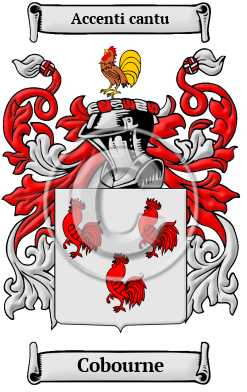
| ![Show Contents]() Cobourne History, Family Crest & Coats of Arms Cobourne History, Family Crest & Coats of Arms
Etymology of CobourneWhat does the name Cobourne mean? The ancestors of the name Cobourne come from the proud Boernician clans of the Scottish-English border region. The Cobourne family lived in Berwickshire named Cockburn. The place name in turn, comes from the Old English cocc, meaning "rooster," and burna, meaning "a stream." As such, the surname is classed as a local, or habitational name, derived from a place where the original bearer lived or held land. Early Origins of the Cobourne familyThe surname Cobourne was first found in Roxburghshire in the lands of Merse. One of the first recorded instances of the name was during the reign of William the Lion (1165-1214) when a Cukoueburn was listed in the area of Clifton, Roxburghshire. Typical of these early entries, no given name was provided. Peter de Cokburne witnessed a grant in 1220. One of the earliest records of a Clan crest was in 1296, when a rooster (cock) is shown on the seal of Peres de Cokeburne. Sir Alexander Cockburn was killed at the battle of Bannockburn in 1314. In 1390, his grandson Alexander was appointed Keeper of the Great Seal of Scotland. Early History of the Cobourne familyThis web page shows only a small excerpt of our Cobourne research. Another 67 words (5 lines of text) covering the years 1281, 1595, 1656, 1685, 1735, 1770 and 1890 are included under the topic Early Cobourne History in all our PDF Extended History products and printed products wherever possible. Cobourne Spelling VariationsSpelling rules had not yet evolved in medieval Scotland, some names dating from that era often appear many different ways. Some spelling variations of Cobourne include Cockburne, Cobourne, Coburn, Coburne, Cocburn, Cockbain, Cockborne, Cockbourn, Cobourn, Cockburn, Cokburn, Cogburn, Cokbain, Cokborne, Cokbourn, Cokbourne, Cokburne, Cowburn and many more. Early Notables of the Cobourne familyAdam Cockburn, Laird of Ormiston, Lord Ormiston (1656-1735), a Scottish administrator, politician and judge; John Cockbourn (1685-1770), Scottish improver of agriculture; Lord Cockburn, a Judge, Author, and Politician; James Cockburn, first M.P. for Muskoka and...
Another 34 words (2 lines of text) are included under the topic Early Cobourne Notables in all our PDF Extended History products and printed products wherever possible. Migration of the Cobourne family to IrelandSome of the Cobourne family moved to Ireland, but this topic is not covered in this excerpt.
Another 69 words (5 lines of text) about their life in Ireland is included in all our PDF Extended History products and printed products wherever possible.
| Cobourne migration to New Zealand | + |
Emigration to New Zealand followed in the footsteps of the European explorers, such as Captain Cook (1769-70): first came sealers, whalers, missionaries, and traders. By 1838, the British New Zealand Company had begun buying land from the Maori tribes, and selling it to settlers, and, after the Treaty of Waitangi in 1840, many British families set out on the arduous six month journey from Britain to Aotearoa to start a new life. Early immigrants include: Cobourne Settlers in New Zealand in the 19th Century- William Cobourne, aged 40, a labourer, who arrived in Auckland, New Zealand aboard the ship "Reiherstieg" in 1864
- Mary Ann Cobourne, aged 36, who arrived in Auckland, New Zealand aboard the ship "Reiherstieg" in 1864
- William Cobourne, aged 4, who arrived in Auckland, New Zealand aboard the ship "Reiherstieg" in 1864
The motto was originally a war cry or slogan. Mottoes first began to be shown with arms in the 14th and 15th centuries, but were not in general use until the 17th century. Thus the oldest coats of arms generally do not include a motto. Mottoes seldom form part of the grant of arms: Under most heraldic authorities, a motto is an optional component of the coat of arms, and can be added to or changed at will; many families have chosen not to display a motto.
Motto: Accenti cantu
Motto Translation: He animates by crowing.
 |