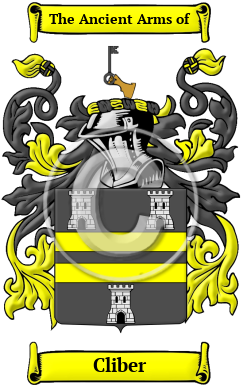
| ![Show Contents]() Cliber History, Family Crest & Coats of Arms Cliber History, Family Crest & Coats of Arms
- Origins Available:
England
Etymology of CliberWhat does the name Cliber mean? The name Cliber has been recorded in British history since the time when the Anglo-Saxons ruled over the region. The name is assumed to have been given to someone who was a person who worked with wood. The surname is derived from the Old English word cleofan which means to cleave or split. 1 2 The variant Clevenger was derived from the occupation "as one who cleaves wood." Two sources postulate that the name could also have originated from "a dweller on a cleave or cliff." 3 1 Early Origins of the Cliber familyThe surname Cliber was first found in Norfolk where Simon le Claver, was listed in the Hundredorum Rolls of 1273. 4 Later, Agnes le Claver and John le Claver were both listed in Norfolk in 1333 5 In London, the source Rotuli Litterarum Clausarum in Turri Londinesi lists Henry le Claver and John le Clavier. In Sussex, Richard and John le Cleuar were listed in the Subsidy Rolls for Sussex in 1332. 1 Early History of the Cliber familyThis web page shows only a small excerpt of our Cliber research. Another 162 words (12 lines of text) covering the years 1273, 1332, 1379, 1742, 1746, 1784, 1785, 1787, 1790, 1800, 1806, 1815 and 1819 are included under the topic Early Cliber History in all our PDF Extended History products and printed products wherever possible. Cliber Spelling VariationsThe first dictionaries that appeared in the last few hundred years did much to standardize the English language. Before that time, spelling variations in names were a common occurrence. The language was changing, incorporating pieces of other languages, and the spelling of names changed with it. Cliber has been spelled many different ways, including Cleever, Cleaver, Clever, Kleever, Kleaver, Cleevar, Cleavar, Cliver, Cleiver, Clivar, Cleevor, Clearvor, Cleevare, Clevenger, Kleevare, Cleavare, Kleavare and many more. Early Notables of the Cliber familyWilliam Cleaver (1742-1815), Bishop of St. Asaph, the eldest son of the Rev. W. Cleaver, master of a private school at Twyford in Buckinghamshire, and was the elder brother of Archbishop Cleaver. Cleaver became tutor to the Marquis of Buckingham. He was successively made vicar of Northop in Flintshire, prebendary of Westminster (1784), master of Brasenose College (1785), bishop of Chester...
Another 61 words (4 lines of text) are included under the topic Early Cliber Notables in all our PDF Extended History products and printed products wherever possible. Migration of the Cliber familyThousands of English families in this era began to emigrate the New World in search of land and freedom from religious and political persecution. Although the passage was expensive and the ships were dark, crowded, and unsafe, those who made the voyage safely were rewarded with opportunities unavailable to them in their homeland. Research into passenger and immigration lists has revealed some of the very first Clibers to arrive in North America: Henry Cleaver who settled in Barbados in 1680 with his servants; Thomas Cleaver settled in Maryland in 1775; Charles Cleaver settled in New England in 1744.
- Reaney, P.H and R.M. Wilson, A Dictionary of English Surnames. London: Routledge, 1991. Print. (ISBN 0-415-05737-X)
- Lower, Mark Anthony, Patronymica Britannica, A Dictionary of Family Names of the United Kingdom. London: John Russel Smith, 1860. Print.
- Arthur, William , An Etymological Dictionary of Family and Christian Names. London: 1857. Print
- Bardsley, C.W, A Dictionary of English and Welsh Surnames: With Special American Instances. Wiltshire: Heraldry Today, 1901. Print. (ISBN 0-900455-44-6)
- Rye, Walter, A History of Norfolk. London: Elliot Stock, 62, Paternoster Row, 1885. Print
 |