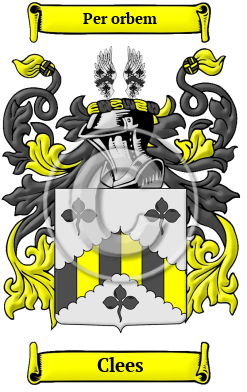
| ![Show Contents]() Clees History, Family Crest & Coats of Arms Clees History, Family Crest & Coats of Arms
Etymology of CleesWhat does the name Clees mean? Clees is one of the many new names that came to England following the Norman Conquest of 1066. The Clees family lived in Lincolnshire, where they held a family seat at Claye. The place name literally means "dweller at the clayey place." 1 Early Origins of the Clees familyThe surname Clees was first found in Lincolnshire where the Hundredorum Rolls of 1273 list William del Cley and Robert del Clay as holding lands there at that time. The same rolls also listed Alicia in le Clay, Huntingdonshire. 2 Later, in Yorkshire, the Yorkshire Poll Tax Rolls of 1379 included: Agnes del Clay; Johannes del Clay; and Adam del Clay, Howdenshire. 2 "Clay has long been a Nottinghamshire surname. It was represented in the parish of Hayton in the time of Henry VII. Hercules Clay was a mayor of Newark in the reign of Charles I. (S.), and Clay is still a Newark name. The Clays of Southwell during last century carried their pedigree back 200 years, and their name is yet in the town. Six centuries ago Clay was a common name in the east of England, especially in Essex, Lincolnshire, Hunts, Cambridgeshire, and Beds. It is still well established in Lincolnshire, as well as in Nottinghamshire and Derbyshire." 3 Early History of the Clees familyThis web page shows only a small excerpt of our Clees research. Another 78 words (6 lines of text) covering the years 1086, 1457, 1537, 1642, 1646, 1766, 1782, 1784, 1786, 1788, 1791, 1794, 1796, 1797, 1821, 1822, 1823, 1828, 1830, 1832, 1834, 1835, 1837, 1839, 1840, 1841, 1842, 1846, 1854, 1857, 1858, 1867 and 1869 are included under the topic Early Clees History in all our PDF Extended History products and printed products wherever possible. Clees Spelling VariationsAnglo-Norman names tend to be marked by an enormous number of spelling variations. This is largely due to the fact that Old and Middle English lacked any spelling rules when Norman French was introduced in the 11th century. The languages of the English courts at that time were French and Latin. These various languages mixed quite freely in the evolving social milieu. The final element of this mix is that medieval scribes spelled words according to their sounds rather than any definite rules, so a name was often spelled in as many different ways as the number of documents it appeared in. The name was spelled Clay, Claye, Cley, Cleye, McClay and others. Early Notables of the Clees familyJohn Claymond (1457?-1537), English divine and scholar, "the son of John Claymond and Alice his wife, 'sufficient inhabitants' of Frampton in Lincolnshire, where John was born." 4
Frederic Clay, son of James Clay, M.P. for Hull was born Aug. 3, 1840, in the Rue Chaillot, Paris. He was educated in music entirely by Molique, with the exception of a short period of instruction at Leipzig...
Another 63 words (4 lines of text) are included under the topic Early Clees Notables in all our PDF Extended History products and printed products wherever possible. Migration of the Clees family to IrelandSome of the Clees family moved to Ireland, but this topic is not covered in this excerpt.
Another 69 words (5 lines of text) about their life in Ireland is included in all our PDF Extended History products and printed products wherever possible. Migration of the Clees familyBecause of the political and religious discontent in England, families began to migrate abroad in enormous numbers. Faced with persecution and starvation at home, the open frontiers and generally less oppressive social environment of the New World seemed tantalizing indeed to many English people. The trip was difficult, and not all made it unscathed, but many of those who did get to Canada and the United States made important contributions to the young nations in which they settled. Some of the first North American settlers with Clees name or one of its variants: Jonathon Clay who settled in Virginia in 1643; Jonas Clay settled in Wells and Cape Porpus in 1636; Steven Clay settled in Barbados with wife child and servants in 1680.
The motto was originally a war cry or slogan. Mottoes first began to be shown with arms in the 14th and 15th centuries, but were not in general use until the 17th century. Thus the oldest coats of arms generally do not include a motto. Mottoes seldom form part of the grant of arms: Under most heraldic authorities, a motto is an optional component of the coat of arms, and can be added to or changed at will; many families have chosen not to display a motto.
Motto: Per orbem
Motto Translation: Through the world.
- Harrison, Henry, Surnames of the United Kingdom: A Concise Etymological Dictionary Baltimore: Geneological Publishing Company, 2013. Print
- Bardsley, C.W, A Dictionary of English and Welsh Surnames: With Special American Instances. Wiltshire: Heraldry Today, 1901. Print. (ISBN 0-900455-44-6)
- Guppy, Henry Brougham, Homes of Family Names in Great Britain. 1890. Print.
- Smith, George (ed), Dictionary of National Biography. London: Smith, Elder & Co., 1885-1900. Print
 |