
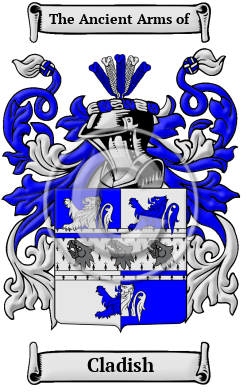
Show ContentsCladish History, Family Crest & Coats of Arms

Etymology of Cladish

What does the name Cladish mean?

The generations and branches of the Cladish family share a name that has its roots in the ancient Anglo-Saxon culture of Britain. The name Cladish comes from the Old English personal name Clad.

Early Origins of the Cladish family

The surname Cladish was first found in Essex where they held a family seat. From their early beginnings, for the next few centuries, the family name also acquired other estates or manors as branches established themselves throughout England. The major conflicts of the eras, such as the War of the Roses, the English Reformation, and the English Civil War sometimes found them to be in opposing camps, with conflicting interests.

Early History of the Cladish family

This web page shows only a small excerpt of our Cladish research. Another 42 words (3 lines of text) covering the years 1387, 1494 and 1499 are included under the topic Early Cladish History in all our PDF Extended History products and printed products wherever possible.

Cladish Spelling Variations

Until quite recently, the English language has lacked a definite system of spelling rules. Consequently, Anglo-Saxon surnames are characterized by a multitude of spelling variations. Changes in Anglo-Saxon names were influenced by the evolution of the English language, as it incorporated elements of French, Latin, and other languages. Although Medieval scribes and church officials recorded names as they sounded, so it is common to find one person referred to by several different spellings of his surname, even the most literate people varied the spelling of their own names. Variations of the name Cladish include Cladish, Claddish, Cleydiche, Claydiche, Claydyche, Gladyche, Gladish and many more.

Early Notables of the Cladish family

More information is included under the topic Early Cladish Notables in all our PDF Extended History products and printed products wherever possible.

Migration of the Cladish family

Searching for a better life, many English families migrated to British colonies. Unfortunately, the majority of them traveled under extremely harsh conditions: overcrowding on the ships caused the majority of the immigrants to arrive diseased, famished, and destitute from the long journey across the ocean. For those families that arrived safely, modest prosperity was attainable, and many went on to make invaluable contributions to the development of the cultures of the new colonies. Research into the origins of individual families in North America revealed records of the immigration of a number of people bearing the name Cladish or a variant listed above: Hugh Gladwish, who came to New York in 1833; William Gladdish, who settled in Toronto in 1871; Stephen Gladish, who came to America in 1881; and John Gladish, who arrived in Ohio in 1882..


Houseofnames.com on Facebook
