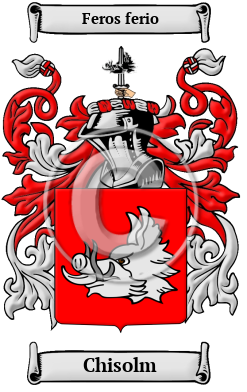
| ![Show Contents]() Chisolm History, Family Crest & Coats of Arms Chisolm History, Family Crest & Coats of Arms
Etymology of ChisolmWhat does the name Chisolm mean? While this Scottish Clan traditionally hails from Scotland, "it has been strongly asserted their Lowland Scotland and northern England origin was because they were actually Norman. The name is Saxon enough, from cisil, gravel, and holm, a river island. Thus Chisholm would mean an islet with a gravel soil." 1 Early Origins of the Chisolm familyThe surname Chisolm was first found in Roxburghshire where the family held the barony of Chisholm in Roberton. 2 Early History of the Chisolm familyThis web page shows only a small excerpt of our Chisolm research. Another 174 words (12 lines of text) covering the years 1176 and 1715 are included under the topic Early Chisolm History in all our PDF Extended History products and printed products wherever possible. Chisolm Spelling VariationsSpelling variations of this family name include: Chisholm, Chissolm, Chisham, Chisholme, Chism, Chisolm, Chisolt, Chissum and many more. Early Notables of the Chisolm familyMore information is included under the topic Early Chisolm Notables in all our PDF Extended History products and printed products wherever possible. Chisolm RankingIn the United States, the name Chisolm is the 3,380th most popular surname with an estimated 9,948 people with that name. 3 Migration of the Chisolm family to IrelandSome of the Chisolm family moved to Ireland, but this topic is not covered in this excerpt. More information about their life in Ireland is included in all our PDF Extended History products and printed products wherever possible.
| Chisolm migration to the United States | + |
Chisolm Settlers in United States in the 19th Century- George Chisolm, who landed in Charleston, South Carolina in 1809 4
| Chisolm migration to Australia | + |
Chisolm Settlers in Australia in the 19th Century- James Chisolm, who arrived in Adelaide, Australia aboard the ship "Sir Edward Parry" in 1849 5
| Chisolm migration to New Zealand | + |
Emigration to New Zealand followed in the footsteps of the European explorers, such as Captain Cook (1769-70): first came sealers, whalers, missionaries, and traders. By 1838, the British New Zealand Company had begun buying land from the Maori tribes, and selling it to settlers, and, after the Treaty of Waitangi in 1840, many British families set out on the arduous six month journey from Britain to Aotearoa to start a new life. Early immigrants include: Chisolm Settlers in New Zealand in the 19th Century- John Chisolm, aged 40, a labourer, who arrived in Wellington, New Zealand aboard the ship "Blenheim" in 1840
- Colin Chisolm, who arrived in Auckland, New Zealand aboard the ship "Bombay" in 1863 6
| Chisolm migration to West Indies | + |
The British first settled the British West Indies around 1604. They made many attempts but failed in some to establish settlements on the Islands including Saint Lucia and Grenada. By 1627 they had managed to establish settlements on St. Kitts (St. Christopher) and Barbados, but by 1641 the Spanish had moved in and destroyed some of these including those at Providence Island. The British continued to expand the settlements including setting the First Federation in the British West Indies by 1674; some of the islands include Barbados, Bermuda, Cayman Island, Turks and Caicos, Jamaica and Belize then known as British Honduras. By the 1960's many of the islands became independent after the West Indies Federation which existed from 1958 to 1962 failed due to internal political conflicts. After this a number of Eastern Caribbean islands formed a free association. 7Chisolm Settlers in West Indies in the 18th Century- Dr. Chisolm, who settled in Jamaica in 1774
| Contemporary Notables of the name Chisolm (post 1700) | + |
- Henry Clay Chisolm (b. 1859), American Republican politician, Physician; Member of Pennsylvania State Senate 33rd District, 1897-1900 8
- Kathryn Chisolm Nadeau, American Republican politician, Delegate to Republican National Convention from Minnesota, 2008
The motto was originally a war cry or slogan. Mottoes first began to be shown with arms in the 14th and 15th centuries, but were not in general use until the 17th century. Thus the oldest coats of arms generally do not include a motto. Mottoes seldom form part of the grant of arms: Under most heraldic authorities, a motto is an optional component of the coat of arms, and can be added to or changed at will; many families have chosen not to display a motto.
Motto: Feros ferio
Motto Translation: I am fierce with the fierce.
- Lower, Mark Anthony, Patronymica Britannica, A Dictionary of Family Names of the United Kingdom. London: John Russel Smith, 1860. Print.
- Reaney, P.H and R.M. Wilson, A Dictionary of English Surnames. London: Routledge, 1991. Print. (ISBN 0-415-05737-X)
- "What are the 5,000 Most Common Last Names in the U.S.?". NameCensus.com, https://namecensus.com/last-names/
- Filby, P. William, Meyer, Mary K., Passenger and immigration lists index : a guide to published arrival records of about 500,000 passengers who came to the United States and Canada in the seventeenth, eighteenth, and nineteenth centuries. 1982-1985 Cumulated Supplements in Four Volumes Detroit, Mich. : Gale Research Co., 1985, Print (ISBN 0-8103-1795-8)
- State Records of South Australia. (Retrieved 2010, November 5) The SIR EDWARD PARRY 1849. Retrieved from http://www.slsa.sa.gov.au/BSA/1849SirEdwardParry.htm
- New Zealand Yesteryears Passenger Lists 1800 to 1900 (Retrieved 7th November 2010). Retrieved from http://www.yesteryears.co.nz/shipping/passlist.html
- https://en.wikipedia.org/wiki/British_West_Indies
- The Political Graveyard: Alphabetical Name Index. (Retrieved 2015, October 21) . Retrieved from http://politicalgraveyard.com/alpha/index.html
 |