| ![Show Contents]() Chacker History, Family Crest & Coats of Arms Chacker History, Family Crest & Coats of Arms
- Origins Available:
England
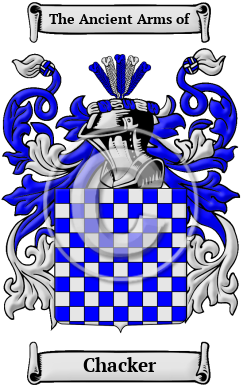
Etymology of ChackerWhat does the name Chacker mean? The Chacker family name dates back to the ancient Anglo-Saxon culture of Britain. The name comes from when an early member worked as a maker of chessboards, or an accountant to a king which is derived from the Old English word cheker, from the Anglo-French word escheker, which was the word for a chess board. Originally, it denoted a maker of chess boards. Later, escheker became the word for a table of accounts. More specifically, it meant the king's table of accounts, the Court of the Exchequer. The name Chacker is related to the word exchequer, which indicated a person who worked as a clerk in the Court of the Exchequer. Early Origins of the Chacker familyThe surname Chacker was first found in Hampshire where they held a family seat from ancient times. Early History of the Chacker familyThis web page shows only a small excerpt of our Chacker research. Another 206 words (15 lines of text) covering the years 1256, 1279, 1316, 1327, 1377 and 1500 are included under the topic Early Chacker History in all our PDF Extended History products and printed products wherever possible. Chacker Spelling VariationsChacker has been spelled many different ways. Before English spelling became standardized over the last few hundred years, spelling variations in names were a common occurrence. As the English language changed in the Middle Ages, absorbing pieces of Latin and French, as well as other languages, the spelling of people's names also changed considerably, even over a single lifetime. Many variations of the name Chacker have been found, including Checker, Cheker, Le Cheker, Chequer and others. Early Notables of the Chacker familyMore information is included under the topic Early Chacker Notables in all our PDF Extended History products and printed products wherever possible.
| Chacker migration to New Zealand | + |
Emigration to New Zealand followed in the footsteps of the European explorers, such as Captain Cook (1769-70): first came sealers, whalers, missionaries, and traders. By 1838, the British New Zealand Company had begun buying land from the Maori tribes, and selling it to settlers, and, after the Treaty of Waitangi in 1840, many British families set out on the arduous six month journey from Britain to Aotearoa to start a new life. Early immigrants include: Chacker Settlers in New Zealand in the 19th Century- David Chacker, aged 21, a farm labourer, who arrived in Nelson, New Zealand aboard the ship "Chile" in 1874
- Caroline Chacker, aged 24, who arrived in Nelson, New Zealand aboard the ship "Chile" in 1874
 |