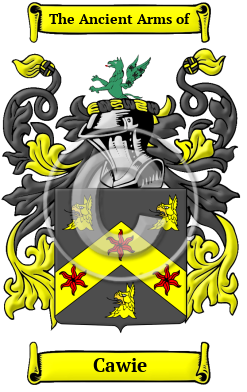
| ![Show Contents]() Cawie History, Family Crest & Coats of Arms Cawie History, Family Crest & Coats of Arms
Etymology of CawieWhat does the name Cawie mean? Among the all the peoples of ancient Scotland, the first to use the name Cawie were the Strathclyde-Britons. It was a name for someone who lived in the parish of Hutton Corrie in the county of Dumfriesshire. 1 It should be noted that the name is now both a Scottish 1 and Northern Irish 2 surname as the name is frequently derived from the root Celtic word "corr" which means "spear," as in "strong as a spear." Early Origins of the Cawie familyThe surname Cawie was first found in Dumfriesshire (Gaelic: Siorrachd Dhùn Phris), a Southern area, bordering on England that today forms part of the Dumfries and Galloway Council Area where the first record was that of Hugh de Corrie who witnessed a charter of a fishery in Torduf c. 1194-1211, and as de Corri, he witnessed resignation of land in Weremundebi and Anant within the same period. Radulph de Cony witnessed a charter by Henry de Grahame a. 1200. Walterus de Corri and Nicholas de Corri witnessed a charter by the Earl of Carrick c. 1271, and Nicholas is recorded as steward of Annandale in that year. Walter de Corry or de Corri, cousin and one of the heirs of Helewisa de Levynton, rendered homage to Edward I in 1274. 1 Early History of the Cawie familyThis web page shows only a small excerpt of our Cawie research. Another 177 words (13 lines of text) covering the years 1194, 1296, 1379, 1398, 1449, 1526, 1547, 1777, 1793, 1797, 1837, 1857 and 1885 are included under the topic Early Cawie History in all our PDF Extended History products and printed products wherever possible. Cawie Spelling VariationsThe variation in the spelling of Medieval names is a result of the lack of spelling rules in the English language prior to the last few hundred years. Before that time, scribes spelled according to sound, often varying the spelling of name within a single document. Cawie has appeared as Corrie, Corry, Corey, Correy, Corrye, Corie, Cory, Cawrie, Cawrey and many more. Early Notables of the Cawie familyArchibald Corrie (1777-1857), Scottish agriculturist, a native of Perthshire, where he was born in 1777. In 1797 he obtained a situation in a nursery near Edinburgh, which he held for some years. Afterwards he became manager of the estate of Annat, Perthshire, farming also on his own account. For many years his agricultural reports contributed to the Scottish newspapers were read with interest in all parts of the kingdom. 3
Daniel Corrie (1777-1837), was Bishop of Madras and was the son of the Rev. John Corrie...
Another 85 words (6 lines of text) are included under the topic Early Cawie Notables in all our PDF Extended History products and printed products wherever possible. Migration of the Cawie family to IrelandSome of the Cawie family moved to Ireland, but this topic is not covered in this excerpt.
Another 84 words (6 lines of text) about their life in Ireland is included in all our PDF Extended History products and printed products wherever possible. Migration of the Cawie familyAs the persecution of Clan families continued, they sailed for North America in increasing numbers. In most cases, they found the freedom and opportunity they sought. Land was often available and the American War of Independence allowed Scots an opportunity to solidify their independence from the English crown. These settlers and their ancestors went on to play essential roles in the forging of the nations of the United States and Canada. Among them: Ann Correy settled in Pennsylvania in 1771; followed by Martha in 1772; and Michael in 1868; Alexander, Jane, Margaret, Nicholas, Robert and William Corrie arrived in Charles Town [Charleston], South Carolina in the 18th century.
- Black, George F., The Surnames of Scotland Their Origin, Meaning and History. New York: New York Public Library, 1946. Print. (ISBN 0-87104-172-3)
- MacLysaght, Edward, More Irish Families. Dublin: Irish Academic Press, 1982. Print. (ISBN 0-7165-0126-0)
- Smith, George (ed), Dictionary of National Biography. London: Smith, Elder & Co., 1885-1900. Print
 |