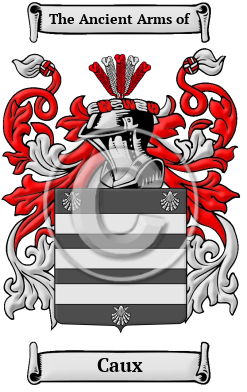
| ![Show Contents]() Caux History, Family Crest & Coats of Arms Caux History, Family Crest & Coats of Arms
Etymology of CauxWhat does the name Caux mean? The surname Caux comes from the region of Gascogne in southwest France. It was a name for someone who lived in Gascoigne. John de Caleto or Caux (d. 1263), Treasurer of England, was "probably a native of the Pays de Caux. By Matthew Paris he is called John of Caen (Johannes de Cadamo), and other writers give his cognomen in the various forms De Calceto, De Cauz, De Cauaz, De Caus, and De Chauce. The Peterborough chronicler, Walter of Whittlesea, who wrote in the fourteenth century, states that he was born in Normandy, of a noble family, being related to Eleanor of Provence, the queen of Henry III, and entered the monastic life when a child seven years of age. Coming over to England at an early age, he became a monk of the monastery of St. Swithhun, Winchester, of which he was chosen prior in 1247." 1 Early Origins of the Caux familyThe surname Caux was first found in Gascony (French: Gascogne), an area of southwest France bordering Spain, that was part of the "Province of Guyenne and Gascony" prior to the French Revolution, where the family held a family seat in ancient times. Antoine Casse, born in 1639, son of Noel and Michelle of St.Pierre, travelled from France to Canada in the 17th century. After arriving in Quebec he married Piloy De Pitie, born in 1639, daughter of François and Claudine, at Château-Richer on 14th October 1665. They remained together in Quebec until Antoine's death on 1st June 1709. Piloy passed away on 28th February 1713. 2 Early History of the Caux familyThis web page shows only a small excerpt of our Caux research. Another 97 words (7 lines of text) covering the years 1576, 1630, 1646, 1672, 1673, 1715, 1719, 1741, 1765, 1792, 1793, 1800, 1810 and 1820 are included under the topic Early Caux History in all our PDF Extended History products and printed products wherever possible. Caux Spelling VariationsMost surnames have experienced slight spelling changes. A son may not chose to spell his name the same way that his father did. Many were errors, many deliberate. During the early development of the French language, a person usually gave his version, phonetically, to a scribe, a priest, or a recorder. Prefixes or suffixes varied. They were optional as they passed through the centuries, or were adopted by different branches to signify either a political or religious adherence. Hence, there a many spelling variations of the name Caux, including Casse, Cassé, Cassée, Casset, Casser, Cassez, Casson, Cassonne, Casault, Casot, Caseau, Caseaux, Casseau, Casseaux, Cassaud, Cazeau, Cazeaux, Cazot, Cazotte, Cazault, Cazaud, Caze, Cazes, Lecasse, Lacasse, Lecassé, Lacassé, Lacassée, Lecasset, Lacasset, Lacaze, Lecasson, Lacasonne, Lecasault, Lacazeau, Ducasse, Ducassé, Ducasset, Ducasson, Ducasault, de Casson, de Cassonne, de Caze, de Cazes, Descaseaux, Deschaseaux and many more. Early Notables of the Caux family- Salomon De Caus, Cauls or Caux (1576-1630), French engineer and architect, a native of Normandy, probably of the town of Caux, was born in 1576. 1
Caux RankingIn France, the name Caux is the 3,290th most popular surname with an estimated 2,000 - 2,500 people with that name. 3
| Caux migration to the United States | + |
By 1643 there were only about 300 people in Quebec. Since immigration was slow, early marriage was desperately encouraged amongst the immigrants. The fur trade attracted migrants, both noble and commoner. 15,000 explorers left Montreal in the late 17th and 18th centuries. By 1675, there were 7000 French in Quebec. By the same year the Acadian presence in Nova Scotia, New Brunswick and Prince Edward Island had reached 500. In 1755, 10,000 French Acadians refused to take an oath of allegiance to England and were deported to Louisiana. The French founded Lower Canada, thus becoming one of the two great founding nations of Canada. The distinguished family name Caux has made significant contributions to the culture, arts, sciences and religion of France and New France. Amongst the settlers in North America with this distinguished name Caux were
Caux Settlers in United States in the 19th Century- H Caux, aged 24, who arrived in New York in 1854 4
| Contemporary Notables of the name Caux (post 1700) | + |
- Louis-Victor de Caux de Blacquetot, French Brigadier General during the French Revolutionary and Napoleonic Wars from 1789 to 1815 5
- Jean-Baptiste de Caux de Blacquetot, French Divisional General during the French Revolutionary and Napoleonic Wars from 1789 to 1815 6
- Pierre-Jean de Caux de Blacquetot, French Brigadier General during the French Revolutionary and Napoleonic Wars from 1789 to 1815 7
- Smith, George (ed), Dictionary of National Biography. London: Smith, Elder & Co., 1885-1900. Print
- Olivier, Reginald L. Your Ancient Canadian Family Ties. Logan: The Everton Publishers, Inc., P.O. Box 368, 1972. Print
- http://www.journaldesfemmes.com/nom-de-famille/nom/
- Filby, P. William, Meyer, Mary K., Passenger and immigration lists index : a guide to published arrival records of about 500,000 passengers who came to the United States and Canada in the seventeenth, eighteenth, and nineteenth centuries. 1982-1985 Cumulated Supplements in Four Volumes Detroit, Mich. : Gale Research Co., 1985, Print (ISBN 0-8103-1795-8)
- Generals Who Served in the French Army during the Period 1789-1815. (Retrieved 2015, February 11) Louis-Victor Caux. Retrieved from http://www.napoleon-series.org/research/c_frenchgenerals.html
- Generals Who Served in the French Army during the Period 1789-1815. (Retrieved 2015, February 11) Jean-Baptiste Caux. Retrieved from http://www.napoleon-series.org/research/c_frenchgenerals.html
- Generals Who Served in the French Army during the Period 1789-1815. (Retrieved 2015, February 11) Pierre-Jean Caux. Retrieved from http://www.napoleon-series.org/research/c_frenchgenerals.html
 |