| ![Show Contents]() Caulfeild History, Family Crest & Coats of Arms Caulfeild History, Family Crest & Coats of Arms
- Origins Available:
Ireland
Etymology of CaulfeildWhat does the name Caulfeild mean? The Irish name Caulfeild has been taken as synonym for many other names. The Gaelic form of the name Caulfeild was generally Mac Cathmhaoil. The name Caulfield was used by people of the Irish names Ó Gamhna, Ó Caibheanaigh and Mac Conghamhna, and Mac Carrghamhna. 1 The Anglicized form of these last four Irish surnames is Gaffney, but for some obscure reason, this has often been changed to Caulfield. Early Origins of the Caulfeild familyThe surname Caulfeild was first found in Fermanagh (Irish: Fear Manach) in the southwestern part of Northern Ireland, Province of Ulster, where they held a family seat from ancient times. They were directly descended from King Colla da Crioch through the Maguires, Princes of Fermanagh. Castle Caulfield is a large ruined house in Castlecaulfield, County Tyrone. At one time, the building was three stories high with large windows and tall chimney stacks. A wooden joist from the castle eludes to the age of the building as about 1282. The Caulfeild Coat of Arms is still seen over the entrance. Nearby, Sir Toby Caulfeild, 1st Baron Caulfeild (1565-1627) built a house on the site of an earlier O'Donnelly castle. It was burned in the Irish Rebellion of 1641, but was rebuilt in the 1660s. Today Castle Caulfield is a ruin and declared a State Care Historic Monument. Early History of the Caulfeild familyThis web page shows only a small excerpt of our Caulfeild research. Another 219 words (16 lines of text) covering the years 1530, 1545, 1565, 1570, 1587, 1607, 1621, 1622, 1624, 1627, 1640, 1642, 1671, 1682, 1685, 1715, 1716, 1717, 1726 and 1734 are included under the topic Early Caulfeild History in all our PDF Extended History products and printed products wherever possible. Caulfeild Spelling VariationsBefore widespread literacy came to Ireland, a name was often recorded under several different variations during the life of its bearer. Accordingly, numerous spelling variations were revealed in the search for the origin of the name Caulfeild family name. Variations found include Caulfeild, Caulkin, Calfkins, Cawlfield, Cawfield, MacCaul, MacCawell and many more. Early Notables of the Caulfeild family- Sir Toby or Tobias Caulfeild first Baron Charlemont (1565-1627), descended from a family which had been settled in Oxfordshire for many generations, his father being Alexander Caulfeild of Great Milto...
- Continuing this noble line was: William Caulfeild (1587-1640), 2nd Baron Caulfeild; Toby Caulfeild (1621-1642), 3rd Baron Caulfeild; Robert Caulfeild (1622-1642), 4th Baron Caulfeild; William Caulfeil...
Migration of the Caulfeild familyThousands of Irish families left for North American shores in the 19th century. These people were searching for a life unencumbered with poverty, hunger, and racial discrimination. Many arrived to eventually find such conditions, but many others simply did not arrive: victims of the diseased, overcrowded ships in which they traveled to the New World. Those who lived to see North American shores were instrumental in the development of the growing nations of Canada and the United States. A thorough examination of passenger and immigration lists has disclosed evidence of many early immigrants of the name Caulfeild: Mary Caulfield, her husband Thomas and one child, settled in Charles Town [Charleston], South Carolina in 1822; Charlotte Caulfield settled in New Orleans in 1823.
| Contemporary Notables of the name Caulfeild (post 1700) | + |
- James Caulfeild KP PC (1728-1799), 1st Earl of Charlemont, an Irish statesman, second son of James, third Viscount Charlemont 2
- James Molyneux Caulfeild KP (1820-1892), 3rd Earl of Charlemont, an Irish politician and peer, Lord Lieutenant of Armagh (1849-1864), Lord Lieutenant of Tyrone (1864-1892)
- Francis William Caulfeild KP, PC (1775-1863), 2nd Earl of Charlemont, an Irish peer and politician, Lord Lieutenant of Tyrone (1839-1863), Member of Parliament for Armagh County (1798-1799)
- Elizabeth Jane Caulfeild (1834-1882), Irish Countess of Charlemont, wife of the 3rd Earl of Charlemont
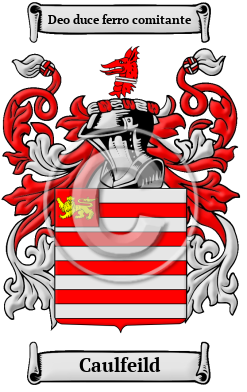
The motto was originally a war cry or slogan. Mottoes first began to be shown with arms in the 14th and 15th centuries, but were not in general use until the 17th century. Thus the oldest coats of arms generally do not include a motto. Mottoes seldom form part of the grant of arms: Under most heraldic authorities, a motto is an optional component of the coat of arms, and can be added to or changed at will; many families have chosen not to display a motto.
Motto: Deo duce ferro comitante
Motto Translation: God is my guide,and my sword is my companion.
- MacLysaght, Edward, The Surnames of Ireland. Ireland: Irish Academic Press, sixth edition, 1985. Print. (ISBN 0-7165-2366-3)
- Wikisource contributors. "Dictionary of National Biography, 1885-1900." Wikisource . Wikisource , 4 Jun. 2018. Web. 25 Nov. 2019
 |