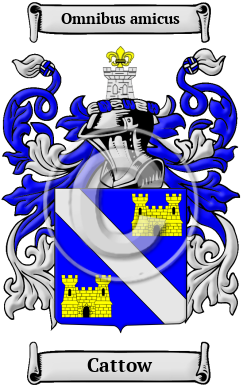
A family of Strathclyde-Briton were the first to use the name Cattow. They lived in Norfolk, England; or the name may also be from Chetel, an Old Norse and Old English given name.
Loading...
Early Origins of the Cattow family
The surname Cattow was first found in Aberdeenshire (Gaelic: Siorrachd Obar Dheathain), a historic county, and present day Council Area of Aberdeen, located in the Grampian region of northeastern Scotland, where they held a family seat from very ancient times.
Early History of the Cattow family
This web page shows only a small excerpt of our Cattow research. Another 67 words (5 lines of text) covering the years 1403, 1597 and 1633 are included under the topic Early Cattow History in all our PDF Extended History products and printed products wherever possible.
Cattow Spelling Variations
In the era before dictionaries, there were no rules governing the spelling or translation of names or any other words. Consequently, there are an enormous number of spelling variations in Medieval Scottish names. Cattow has appeared as Catto, Cattoch, Cattow, Kitto, Citto, Chatto, Chattoch, Chetto, Cato and many more.
Early Notables of the Cattow family
More information is included under the topic Early Cattow Notables in all our PDF Extended History products and printed products wherever possible.
Loading...
Loading...
Loading...
Loading...
Migration of the Cattow family
The freedom, opportunity, and land of the North American colonies beckoned. There, Scots found a place where they were generally free from persecution and where they could go on to become important players in the birth of new nations. Some fought in the American War of Independence, while others went north to Canada as United Empire Loyalists. The ancestors of all of these Scottish settlers have been able to recover their lost national heritage in the last century through highland games and Clan societies in North America. Among them: James Catto who settled in Maryland in 1775; John Catto arrived in Philadelphia in 1754; William Catto arrived in Nevis in 1775.
The motto was originally a war cry or slogan. Mottoes first began to be shown with arms in the 14th and 15th centuries, but were not in general use until the 17th century. Thus the oldest coats of arms generally do not include a motto. Mottoes seldom form part of the grant of arms: Under most heraldic authorities, a motto is an optional component of the coat of arms, and can be added to or changed at will; many families have chosen not to display a motto.
Motto: Omnibus amicus Motto Translation: A friend to everyone.
Remove Item
WARNING!
Removing this item from your shopping cart will remove your associated sale items.
Are you sure you want to delete this item from your shopping cart?
HouseofNames E-Newsletter Sign Up
On Demand Gifts | Digital Products Available 24/7
A Gift for Everyone on your List is a Click Away - Shop Now