| ![Show Contents]() Castling History, Family Crest & Coats of Arms Castling History, Family Crest & Coats of Arms
- Origins Available:
England
Etymology of CastlingWhat does the name Castling mean? The name Castling was carried to England in the enormous movement of people that followed the Norman Conquest of 1066. The Castling family lived in Yorkshire. The family was originally from Chastelai, Normandy, and the name Castling is derived from this place-name. Early Origins of the Castling familyThe surname Castling was first found in Yorkshire where they held a family seat from very early times and were granted lands by Duke William of Normandy, their liege Lord, for their distinguished assistance at the Battle of Hastings in 1066 A.D. Early History of the Castling familyThis web page shows only a small excerpt of our Castling research. Another 70 words (5 lines of text) covering the years 1532, 1550 and 1700 are included under the topic Early Castling History in all our PDF Extended History products and printed products wherever possible. Castling Spelling VariationsEndless spelling variations are a prevailing characteristic of Norman surnames. Old and Middle English lacked any definite spelling rules, and the introduction of Norman French added an unfamiliar ingredient to the English linguistic stew. French and Latin, the languages of the court, also influenced spellings. Finally, Medieval scribes generally spelled words according to how they sounded, so one person was often referred to by different spellings in different documents. The name has been spelled Casserly, Casserley, Casserlay, Castlelaw, Casserlaw, Casterline, Chastelyn, Casteldein and many more. Early Notables of the Castling familyMore information is included under the topic Early Castling Notables in all our PDF Extended History products and printed products wherever possible.
| Castling migration to New Zealand | + |
Emigration to New Zealand followed in the footsteps of the European explorers, such as Captain Cook (1769-70): first came sealers, whalers, missionaries, and traders. By 1838, the British New Zealand Company had begun buying land from the Maori tribes, and selling it to settlers, and, after the Treaty of Waitangi in 1840, many British families set out on the arduous six month journey from Britain to Aotearoa to start a new life. Early immigrants include: Castling Settlers in New Zealand in the 19th Century- Mr. John William Castling, (b. 1826), aged 35, British farm labourer travelling from London aboard the ship "Mystery" arriving in Lyttelton, Christchurch, South Island, New Zealand on 7th January 1862 1
The motto was originally a war cry or slogan. Mottoes first began to be shown with arms in the 14th and 15th centuries, but were not in general use until the 17th century. Thus the oldest coats of arms generally do not include a motto. Mottoes seldom form part of the grant of arms: Under most heraldic authorities, a motto is an optional component of the coat of arms, and can be added to or changed at will; many families have chosen not to display a motto.
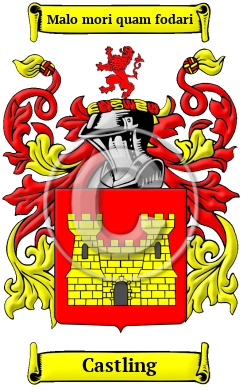
Motto: Malo mori quam fodari
Motto Translation: I would rather die than be disgraced.
- New Zealand Yesteryears Passenger Lists 1800 to 1900 (Retrieved 17th October 2018). Retrieved from http://www.yesteryears.co.nz/shipping/passlist.html
 |