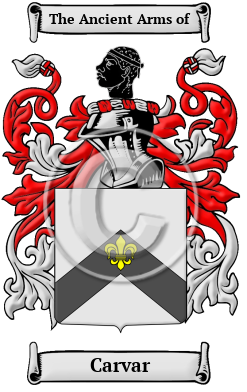
| ![Show Contents]() Carvar History, Family Crest & Coats of Arms Carvar History, Family Crest & Coats of Arms
Etymology of CarvarWhat does the name Carvar mean? The founding heritage of the Carvar family is in the Anglo-Saxon culture that once dominated in Britain. The name Carvar comes from when one of the family worked as a wood-carver or sculptor. The former occupation was more common than the latter. Chaucer describes a wood-carver in the late 13th century "Knight's Tale", writing, "Ne purteyour, ne kerver of images." The surname Carvar is derived from the Old English word ceorfan, which means to cut or to carve. However, the surname Carvar may also be derived from the occupation of a ploughman. In this case, the surname Carvar is derived from the Old French words charuier and caruier, which both mean ploughman. 1 Early Origins of the Carvar familyThe surname Carvar was first found in the Hundredorum Rolls of 1273 where Adam le Karver was listed in Devon and Richard le Kerver was found in Lincolnshire. 2 Years later, the family was found much further to the north in Scotland where "payment was made to John Kerver, merchant of Scotland, 1476. Symon Karwur bound himself to the Abbey of Dunfermelyn in 1507 'for all and hail the dais of his lyfe that he sall remane and wirk in the abba in the craft of the wryt craft and repare all neidfull werkis of the samyn als far has he hafis knawlege' . Robert Carwor witnessed a precept of sasine at Scone, 1544." 3 Early History of the Carvar familyThis web page shows only a small excerpt of our Carvar research. Another 137 words (10 lines of text) covering the years 1203, 1275, 1290, 1490, 1505, 1567, 1576, 1607, 1608, 1620, 1621, 1710 and 1780 are included under the topic Early Carvar History in all our PDF Extended History products and printed products wherever possible. Carvar Spelling VariationsThe first dictionaries that appeared in the last few hundred years did much to standardize the English language. Before that time, spelling variations in names were a common occurrence. The language was changing, incorporating pieces of other languages, and the spelling of names changed with it. Carvar has been spelled many different ways, including Carver, Carvere, Carvar, Carever, Carber, Kerver and many more. Early Notables of the Carvar familyRobert Carver (1490-1567), Scottish Renaissance monk and composer of Christian sacred music.
John Carver (c.1576-1621), was leader of the 'Pilgrim fathers,' an Englishman and agent of the English congregational church at Leyden in Holland. When he sailed in the Mayflower (1620) he was 'of good age,' father of several children, one daughter being aged 14. In his time the name of Carver, alias Calver, was common in the midland counties, and the best conjecture is that he came from Nottinghamshire. He was one of the...
Another 84 words (6 lines of text) are included under the topic Early Carvar Notables in all our PDF Extended History products and printed products wherever possible. Migration of the Carvar familyThousands of English families in this era began to emigrate the New World in search of land and freedom from religious and political persecution. Although the passage was expensive and the ships were dark, crowded, and unsafe, those who made the voyage safely were rewarded with opportunities unavailable to them in their homeland. Research into passenger and immigration lists has revealed some of the very first Carvars to arrive in North America: Richard Carver, who had sailed from Yarmouth in England in 1637; and who had lived at Scratby, in Norfolk, in England. He settled in Watertown in Massachusetts. In all, at this period, there were three settlers, Richard, Edward and Robert. Robert settled at Marshfield, Massachusetts in 1638.
- Harrison, Henry, Surnames of the United Kingdom: A Concise Etymological Dictionary Baltimore: Geneological Publishing Company, 2013. Print
- Bardsley, C.W, A Dictionary of English and Welsh Surnames: With Special American Instances. Wiltshire: Heraldry Today, 1901. Print. (ISBN 0-900455-44-6)
- Black, George F., The Surnames of Scotland Their Origin, Meaning and History. New York: New York Public Library, 1946. Print. (ISBN 0-87104-172-3)
 |