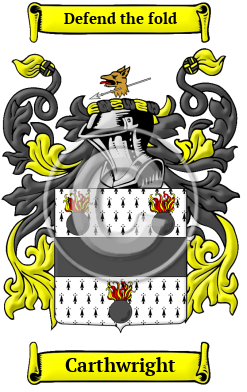
| ![Show Contents]() Carthwright History, Family Crest & Coats of Arms Carthwright History, Family Crest & Coats of Arms
- Origins Available:
England
Etymology of CarthwrightWhat does the name Carthwright mean? The founding heritage of the Carthwright family is in the Anglo-Saxon culture that once dominated in Britain. The name Carthwright comes from when one of the family worked as a maker of carts, and wheels. The name has its origins in the Old English word craet, which means cart, and the Old English word wyrtha, which means wright or maker, thereby denoting one who was the maker of carts or wagons. 1 The name could also have been "from Cauterêts; a location name in Normandy Cateray in Roll of Battell Abbey. De Ceterith, a tenant in chief in the Domesday Book. " 2 Another source notes the family is "armorially identified with Cateryke, or Catherick (Robson). Catherick was part of the demesne of the Earls of Richmond, and the surname therefore probably arose from tenure of the office of Seneschal by a branch of a neighbouring family. The arms (a fesse) are those of the adjoining family of De Smythton or Eschalers, with three cinquefoils for difference, which were afterwards corrupted into ‘roses', 'Catherine wheels', and ‘fire-balls with rays.’ Of this family Ilbert de Catherege, or Catherage (a form of Catheric), occurs in Normandy, 1180-98 (Magni Rotuli Scaccarii Normanniae); which shows the Norman origin of the family. A branch long remained at Stanwick, in Richmondshire, close to Catterick. Another branch was seated in Notts, and one in Cambridge; and the name there changed from Cateryke to Cartwright." 3 Early Origins of the Carthwright familyThe surname Carthwright was first found in Yorkshire where early rolls listed the name as a profession and a surname. The Poll Tax of Howdenshire (East Riding of Yorkshire) listed Robert le Cartwright. B. Johannes Toppe, cartwryght. In the same year the Yorkshire Poll Tax Rolls listed: Magota Cartwryght; Henriciis Wryght, catrwryght (sic); Johannes Warde, cartwright; Johannes Percivale, cartwryght and Geoffrey Cartewirght. 4 Early History of the Carthwright familyThis web page shows only a small excerpt of our Carthwright research. Another 119 words (8 lines of text) covering the years 1273, 1535, 1602, 1603, 1611, 1634, 1635, 1643, 1658, 1659, 1661, 1676, 1686, 1689, 1703 and 1755 are included under the topic Early Carthwright History in all our PDF Extended History products and printed products wherever possible. Carthwright Spelling VariationsThe first dictionaries that appeared in the last few hundred years did much to standardize the English language. Before that time, spelling variations in names were a common occurrence. The language was changing, incorporating pieces of other languages, and the spelling of names changed with it. Carthwright has been spelled many different ways, including Cartwright, Cartright, Cartwrite, Carthright, Kartwright, Kartright, Cartrite, Kartwrite, Chartwright, Cartrite, Catherick, Cartrait, Cartray, Ceterith, Cateray, Cautheret, Carterwright, Carterright, Carterrite, Chartright, Chartwright, Cardwright and many more. Early Notables of the Carthwright familyThomas Cartwright (1535-1603), described by Strype (Annals, ii. i. c. 1) as 'the head and most learned of that sect of dissenters then called Puritans,' was a native of Hertfordshire, but his place of birth is not recorded." 5
Christopher Cartwright (1602-1658), was an English divine, born in the parish of St. Michael-le-Belfry, York. He was a Hebraist and used targums in Biblical exegesis, following the lead of Henry Ainsworth with John Weemes. 5
William Cartwright (1634-1676), was an English politician who sat in the House of Commons in 1659; Thomas Cartwright (1634-1689), was an English bishop and diarist, Bishop of Chester in...
Another 140 words (10 lines of text) are included under the topic Early Carthwright Notables in all our PDF Extended History products and printed products wherever possible. Migration of the Carthwright familyThousands of English families in this era began to emigrate the New World in search of land and freedom from religious and political persecution. Although the passage was expensive and the ships were dark, crowded, and unsafe, those who made the voyage safely were rewarded with opportunities unavailable to them in their homeland. Research into passenger and immigration lists has revealed some of the very first Carthwrights to arrive in North America: Bethia Cartwright who settled in Salem Massachusetts in 1630; John Cartwright settled in Virginia in 1624; Matthew Cartwright settled in Maryland in 1700.
The motto was originally a war cry or slogan. Mottoes first began to be shown with arms in the 14th and 15th centuries, but were not in general use until the 17th century. Thus the oldest coats of arms generally do not include a motto. Mottoes seldom form part of the grant of arms: Under most heraldic authorities, a motto is an optional component of the coat of arms, and can be added to or changed at will; many families have chosen not to display a motto.
Motto: Defend the fold
- Smith, Eldson Coles, New Dictionary of American Family Names New York: Harper & Row, 1956. Print
- Barber, Henry, British Family Names London: Elliot Stock, 62 Paternoster Row, 1894. Print.
- The Norman People and Their Existing Descendants in the British Dominions and the United States Of America. Baltimore: Genealogical Publishing, 1975. Print. (ISBN 0-8063-0636-X)
- Bardsley, C.W, A Dictionary of English and Welsh Surnames: With Special American Instances. Wiltshire: Heraldry Today, 1901. Print. (ISBN 0-900455-44-6)
- Smith, George (ed), Dictionary of National Biography. London: Smith, Elder & Co., 1885-1900. Print
 |