| ![Show Contents]() Carss History, Family Crest & Coats of Arms Carss History, Family Crest & Coats of Arms
- Origins Available:
Scotland
Etymology of CarssWhat does the name Carss mean? The Strathclyde clans of the Scottish/English Borderlands were the first people to use the name Carss. It is derived from the Scotish word kerss, or carse, which describes low, fertile land, often next to a river. The surname may well be a habitational name taken on from any of several places so named, such as Carse of Falkirk, Carse of Forth, Carse of Gowrie, Carse in Kirkcudbrightshire, or Carse in Argyllshire. Early Origins of the Carss familyThe surname Carss was first found in Perthshire (Gaelic: Siorrachd Pheairt) former county in the present day Council Area of Perth and Kinross, located in central Scotland, where they held a family seat from very ancient times, some say well before the Norman Conquest and the arrival of Duke William at Hastings in 1066 A.D. Early History of the Carss familyThis web page shows only a small excerpt of our Carss research. Another 87 words (6 lines of text) covering the years 1206 and 1410 are included under the topic Early Carss History in all our PDF Extended History products and printed products wherever possible. Carss Spelling VariationsIt is only in the last few hundred years that rules have developed and the process of spelling according to sound has been abandoned. Scottish names from before that time tend to appear under many different spelling variations. Carss has been spelled Carse, Carss, Cars, Carsey and others. Early Notables of the Carss familyMore information is included under the topic Early Carss Notables in all our PDF Extended History products and printed products wherever possible.
| Carss migration to the United States | + |
Unwelcome in their beloved homeland, many Scots sailed for the colonies of North America. There, they found land and freedom, and even the opportunity to make a new nation in the American War of Independence. These Scottish settlers played essential roles in the founding of the United States, and the shaping of contemporary North America. Among them:
Carss Settlers in United States in the 19th Century- Herm Carss, German settler who arrived in New York aboard the ship "Emily & Lucy" in 1851 1
- Auguste Carss, aged 26, German settler who arrived in New York aboard the ship "Emily & Lucy" in 1851 1
- Friedr Carss, aged 30, German settler who arrived in New York aboard the ship "Emily & Lucy" in 1851 1
- James Carss, aged 28, Irish settler who arrived in New York aboard the ship "Vigo" in 1859 1
- J. Carss, aged 21, British settler who arrived in New York aboard the ship "Nederland" in 1886 1
Carss Settlers in United States in the 20th Century- Antonina Carss, aged 34, Italian settler who arrived in New York aboard the ship "Archimede" in 1900 1
- Adam Carss, aged 37, Scottish settler who arrived in New York aboard the ship "Furnessia" in 1911 1
- William Carss, aged 28, Scottish settler who arrived in New York aboard the ship "Cameronia" in 1912 1
- Nicolas Carss, aged 33, Greek settler who arrived in New York aboard the ship "Lapland" in 1927 1
- Angus Carss, aged 65, Canadian settler who arrived in New York aboard the ship "Carmania" in 1931 1
| Carss migration to Australia | + |
Carss Settlers in Australia in the 20th Century- Thomas Henry Carss, French settler who arrived in Fremantle, Australia aboard the ship "El Kantara" in 1917 2
- Mid M. Carss, British settler who arrived in Fremantle, Australia aboard the ship "Naldera" in 1920 2
| Contemporary Notables of the name Carss (post 1700) | + |
- William Leighton Carss (1865-1931), American politician, Representative from Minnesota 8th District, 1919-21, 1925-29; Defeated, 1920, 1922, 1928, 1930 3
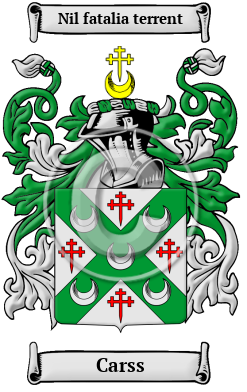
The motto was originally a war cry or slogan. Mottoes first began to be shown with arms in the 14th and 15th centuries, but were not in general use until the 17th century. Thus the oldest coats of arms generally do not include a motto. Mottoes seldom form part of the grant of arms: Under most heraldic authorities, a motto is an optional component of the coat of arms, and can be added to or changed at will; many families have chosen not to display a motto.
Motto: Nil fatalia terrent
Motto Translation: Things decreed by fate do not dismay us
- Ellis Island Search retrieved 21st October 2021. Retrieved from https://heritage.statueofliberty.org/passenger-result
- National Archives of Australia retrieved 21st October 2021. Retrieved from https://recordsearch.naa.gov.au
- The Political Graveyard: Alphabetical Name Index. (Retrieved 2015, November 12) . Retrieved from http://politicalgraveyard.com/alpha/index.html
 |