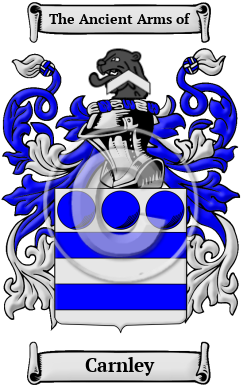
| ![Show Contents]() Carnley History, Family Crest & Coats of Arms Carnley History, Family Crest & Coats of Arms
Etymology of CarnleyWhat does the name Carnley mean? The ancient roots of the Carnley family name are in the Anglo-Saxon culture. The name Carnley comes from when the family lived in the region of Carnaby a parish in the East Riding of Yorkshire. Literally the place name means 'cairn-settlement' from the Celtic carn, cairn + Scandinavian by, meaning 'settlement, village.' 1 Early Origins of the Carnley familyThe surname Carnley was first found in Carnaby, a parish, in the "union of Bridlington, wapentake of Dickerin in the East Riding of Yorkshire. The church is a small edifice, with an embattled tower." 2 The first records for the family are found here in the Yorkshire Poll Tax Rolls of 1379: Rogerus de Carnaby, brasiator; and Johannes Carnaby. 3 Later records of the family were found further to the north in Caithness, Scotland, specifically with the spelling Carnabay, but that sources notes the family was "from Carnaby in the East Riding of Yorkshire." 4 Early History of the Carnley familyThis web page shows only a small excerpt of our Carnley research. Another 143 words (10 lines of text) covering the years 1404, 1407, 1541, 1552, 1595, 1624, 1628, 1629, 1640, 1642, 1645, 1669, 1677, 1772, 1805, 1808, 1823 and 1839 are included under the topic Early Carnley History in all our PDF Extended History products and printed products wherever possible. Carnley Spelling VariationsOne relatively recent invention that did much to standardize English spelling was the printing press. However, before its invention even the most literate people recorded their names according to sound rather than spelling. The spelling variations under which the name Carnley has appeared include Carnaby, Carnabey and others. Early Notables of the Carnley familySir William Carnaby (died 1407), English politician, Member of Parliament for Northumberland in 1404; Leonard Cornaby, High Sheriff of Northumberland in 1541; and William Carnaby (1595-1645), an English politician, Member of Parliament for Morpeth in 1624; for Northumberland (1628-1629), for Marlborough in 1640, and for Morpeth (1640-1642.)
William Carnaby, born in London in 1772, was a chorister of the Chapel-Royal under Dr. Nares and Dr. Ayrton. On leaving the choir he became organist at Eye, which he quitted for...
Another 77 words (6 lines of text) are included under the topic Early Carnley Notables in all our PDF Extended History products and printed products wherever possible. Migration of the Carnley familyAt this time, the shores of the New World beckoned many English families that felt that the social climate in England was oppressive and lacked opportunity for change. Thousands left England at great expense in ships that were overcrowded and full of disease. A great portion of these settlers never survived the journey and even a greater number arrived sick, starving, and without a penny. The survivors, however, were often greeted with greater opportunity than they could have experienced back home. These English settlers made significant contributions to those colonies that would eventually become the United States and Canada. An examination of early immigration records and passenger ship lists revealed that people bearing the name Carnley arrived in North America very early: Elizabeth Carnaby who settled in Virginia in 1741.
- Harrison, Henry, Surnames of the United Kingdom: A Concise Etymological Dictionary Baltimore: Geneological Publishing Company, 2013. Print
- Lewis, Samuel, A Topographical Dictionary of England. Institute of Historical Research, 1848, Print.
- Bardsley, C.W, A Dictionary of English and Welsh Surnames: With Special American Instances. Wiltshire: Heraldry Today, 1901. Print. (ISBN 0-900455-44-6)
- Black, George F., The Surnames of Scotland Their Origin, Meaning and History. New York: New York Public Library, 1946. Print. (ISBN 0-87104-172-3)
 |