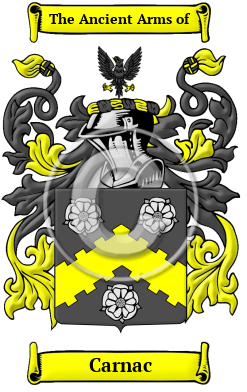
| ![Show Contents]() Carnac History, Family Crest & Coats of Arms Carnac History, Family Crest & Coats of Arms
Etymology of CarnacWhat does the name Carnac mean? The surname Carnac is a Welsh name that was first held when the Carnac family lived in the English county of Cornwall. As a general rule, the greater the distance between individuals and their homelands, the larger the territory they were named after. For example, people who only moved to another parish would be known by the name of their original village, while people who migrated to a different country were often known by the name of a region or country from which they came. Consequently, the name Carnac was not originally applied to a lifelong resident of Cornwall, but rather to someone who emigrated from Cornwall to another region. 1 Early Origins of the Carnac familyThe surname Carnac was first found in Devon, England where the "surname is derived from a geographical locality. 'the Cornish,' a Cornish man. We do not expect to find Cornish in Cornwall, but in Devonshire. Coming over the border the stranger would be called Cornish from the county he had left. Hence Cornish is rare in Cornwall and common in Devonshire. We may safely conclude that when we find Cornish in Cornwall the bearer has returned to the county whence his ancestors sprang." 2 "The manor of Trevorick, [in St. Issey, Cornwall] on which the family of Cornish had their seat, was for several generations in their possession." 3 "The Devonshire families of Cornish are now best represented in Newton Abbot and its neighbourhood. George Cornish was commander of one of the Bideford ships engaged in the Newfoundland trade in the reign of William III. " 4 In Devon, Thomas Cornyssh was Warden of St Mary's College, Ottery St Mary in 1490. "In the parish registers [of Stratton, Cornwall] is preserved the following singular instance of longevity:-'Elizabeth Cornish, widow, buried March 10th, 1691. This Elizabeth Cornish was baptised in October, 1578. Her father's name was John Weale. She was when she died in the 114th year, having lived one hundred and thirteen years four months and fifteen days.' It appears by the register that in the year 1547, one hundred and fifty-three persons died in the small town of Stratton of the plague." 3 Early History of the Carnac familyThis web page shows only a small excerpt of our Carnac research. Another 116 words (8 lines of text) covering the years 1296, 1375, 1450, 1465, 1493, 1502, 1523, 1677, 1685 and 1689 are included under the topic Early Carnac History in all our PDF Extended History products and printed products wherever possible. Carnac Spelling VariationsAlthough there are comparatively few Welsh surnames, they have a great many spelling variations. Variations of Welsh names began almost immediately after their acceptance within Welsh society. In the Middle Ages, it was up to priests and the few other people that recorded names in official documents to decide how to spell the names that they heard. Variations that occurred because of improper recording increased dramatically as the names were later transliterated into English. The Brythonic Celtic language of Wales, known by natives as Cymraeg, featured many highly inflected sounds that could not be properly captured by the English language. Spelling variations were, however, also carried out according to an individual's design: a branch loyalty within the family, a religious adherence, or even patriotic affiliations were all indicated by the particular variation of one's name. The spelling variations of the name Carnac have included Cornish, Cornishe, Corniss, Cornise, Carnish, Cornich, Corniche, Cornick and many more. Early Notables of the Carnac familyWilliam Cornysh the Younger (also spelled Cornyshe or Cornish) (1465-1523), an English composer, dramatist, actor, and poet. His only surviving poem, was written in Fleet Prison. " In the Privy Purse Expenses of Henry VII under date Nov. 12, 1493, a payment is entered 'to one Cornyshe for a prophecy in rewarde, 13s. 4d.,' and in the Privy Purse Expenses of Henry's Queen, Elizabeth of York, under date Dec. 1502, a similar amount for 'setting of a carralle upon Christmas day.' " 5
His son, William Cornyshe, Jr., was a composer in the early part of the...
Another 95 words (7 lines of text) are included under the topic Early Carnac Notables in all our PDF Extended History products and printed products wherever possible.
| Carnac migration to the United States | + |
The Welsh began to emigrate to North America in the late 1800s and early 1900s in search of land, work, and freedom. Those that arrived helped shape the industry, commerce, and the cultural heritage of both Canada and the United States. The records regarding immigration and passenger show a number of people bearing the name Carnac:
Carnac Settlers in United States in the 19th Century- C N Carnac, who landed in San Francisco, California in 1851 6
| Contemporary Notables of the name Carnac (post 1700) | + |
- John Carnac (1716-1800), British colonel who commenced his military service in the 39th foot ('Primus in India'), and, being in India when that regiment was ordered home in 1758, was admitted into the East India Company's service with the rank of captain 7
- Sir James Rivett Carnac (1785-1846), Governor of Bombay who entered the East India Company's service in 1801 as an officer the Madras native infantry 8
- Lower, Mark Anthony, Patronymica Britannica, A Dictionary of Family Names of the United Kingdom. London: John Russel Smith, 1860. Print.
- Bardsley, C.W, A Dictionary of English and Welsh Surnames: With Special American Instances. Wiltshire: Heraldry Today, 1901. Print. (ISBN 0-900455-44-6)
- Hutchins, Fortescue, The History of Cornwall, from the Earliest Records and Traditions to the Present Time. London: William Penaluna, 1824. Print
- Guppy, Henry Brougham, Homes of Family Names in Great Britain. 1890. Print.
- Grove, Sir George, A Dictionary of Music and Musicians (AD. 1450-1889) London: Macmillan1902, Print, 2 Vols
- Filby, P. William, Meyer, Mary K., Passenger and immigration lists index : a guide to published arrival records of about 500,000 passengers who came to the United States and Canada in the seventeenth, eighteenth, and nineteenth centuries. 1982-1985 Cumulated Supplements in Four Volumes Detroit, Mich. : Gale Research Co., 1985, Print (ISBN 0-8103-1795-8)
- Wikisource contributors. "Dictionary of National Biography, 1885-1900." Wikisource . Wikisource , 4 Jun. 2018. Web. 31 Oct. 2019
 |