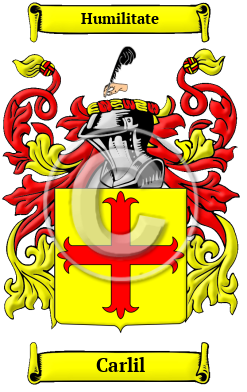
| ![Show Contents]() Carlil History, Family Crest & Coats of Arms Carlil History, Family Crest & Coats of Arms
- Origins Available:
Scotland
Ireland
Etymology of CarlilWhat does the name Carlil mean? Scottish history reveals Carlil was first used as a surname by the Strathclyde-Briton people. It was a name for someone who lived in the city of Carlisle in the county of Cumberland in the Scottish/English borders. Early Origins of the Carlil familyThe surname Carlil was first found in Cumberland, at Carlisle. "It was anciently called Caer-Luil, or Caer Leol, signifying "the city of Luil," a British potentate, who is reputed to have been its founder. The Romans, on selecting it for a station, changed the name to Lugovallum, which is probably derived from Lugus or Lucu, a "tower" or "fort," in the Celtic tongue, and Vallum, in allusion to Adrian's vallum, which passed near. From its earliest foundation till the union of the English and Scottish kingdoms, the town suffered those shocks of incursive warfare to which, as a border town, it was peculiarly exposed, and by which it was repeatedly overwhelmed. " 1 "The surname crossed the Border, the spelling undergoing slight changes. Still it is easy to see that Thomas Carlyle was born and brought up not very far from the city whence his ancestors originally sprang." 2 The Yorkshire Poll Tax Rolls of 1379 pointed to the wide spelling variations that were in use at that time: Thomas de Carlell; Willelmus de Karleyll, osllr; and Walterus de Carlhill. 2 Slightly further to the north in Scotland, "the first of the name who appears in Scotland is Odard de Carlyle, who witnessed a charter by Uchtred, son of Fergus, lord of Galloway, to the Hospital of St. Peter at York between 1158-1164. He appears to have also held the land of Hoddam as he is described as Odard de Hodelme. Evdone de Karleolo or Eudo de Karliol, c. 1207, was witness to a charter by Eustace de Vescy of 20l. per annum out of the mill of Sprouiston to the Abbey of Kelso." 3 Early History of the Carlil familyThis web page shows only a small excerpt of our Carlil research. Another 152 words (11 lines of text) covering the years 1500, 1551, 1593, 1622, 1629, 1664, 1680, 1682, 1691, 1795, 1881 and 1890 are included under the topic Early Carlil History in all our PDF Extended History products and printed products wherever possible. Carlil Spelling VariationsIt is only in the last few hundred years that rules have developed and the process of spelling according to sound has been abandoned. Scottish names from before that time tend to appear under many different spelling variations. Carlil has been spelled Carlisle, Carlysle, Carleill, Carlyle, Carlile, Carliell and many more. Early Notables of the Carlil family- Anne Carlile or Carlisle (d. 1680?), was an English artist who "was largely employed in copying the paintings of the Italian masters, and in reproducing these in miniature; Charles I was so warm an ad...
- James Carlile S (d. 1691), was an English actor and dramatist, a native of Lancashire, and joined the company at Drury Lane at some time previous to 1682. 4
Migration of the Carlil family to IrelandSome of the Carlil family moved to Ireland, but this topic is not covered in this excerpt.
Another 61 words (4 lines of text) about their life in Ireland is included in all our PDF Extended History products and printed products wherever possible. Migration of the Carlil familyUnwelcome in their beloved homeland, many Scots sailed for the colonies of North America. There, they found land and freedom, and even the opportunity to make a new nation in the American War of Independence. These Scottish settlers played essential roles in the founding of the United States, and the shaping of contemporary North America. Among them: John Carlisle who settled in Augusta Virginia in 1730; James Carlisle settled in Charles Town [Charleston], South Carolina in 1821 with his wife Mary and four children.
The motto was originally a war cry or slogan. Mottoes first began to be shown with arms in the 14th and 15th centuries, but were not in general use until the 17th century. Thus the oldest coats of arms generally do not include a motto. Mottoes seldom form part of the grant of arms: Under most heraldic authorities, a motto is an optional component of the coat of arms, and can be added to or changed at will; many families have chosen not to display a motto.
Motto: Humilitate
Motto Translation: With humility.
- Lewis, Samuel, A Topographical Dictionary of England. Institute of Historical Research, 1848, Print.
- Bardsley, C.W, A Dictionary of English and Welsh Surnames: With Special American Instances. Wiltshire: Heraldry Today, 1901. Print. (ISBN 0-900455-44-6)
- Black, George F., The Surnames of Scotland Their Origin, Meaning and History. New York: New York Public Library, 1946. Print. (ISBN 0-87104-172-3)
- Smith, George (ed), Dictionary of National Biography. London: Smith, Elder & Co., 1885-1900. Print
 |