| ![Show Contents]() Cammell History, Family Crest & Coats of Arms Cammell History, Family Crest & Coats of Arms
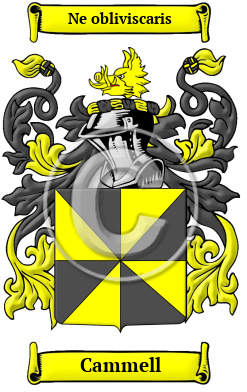
Etymology of CammellWhat does the name Cammell mean? A Strathclyde-Briton family from the Scottish/English Borderlands was the first to use the surname Cammell. It is a name for a person with a crooked mouth, or crooked smile. This nickname surname is derived from the Gaelic words cam and beul, meaning crooked and mouth. Nicknames could be derived from various sources. In general, they came from the physical characteristics, behavior, mannerisms and other attributes of the bearer. Cammell Coat of Arms CreationAccording to Scottish lore, the case of the Duke of Argyll, whose crest is a boar's head, goes back to the time of the Fenian heroes. The ancestor of the Argyll clan was then known as Diarmid. Unhappily Fionn's wife fell in love with Diarmid while he was one night at a feast in her husband's castle. Fionn found this out, and consulted a witch as to what he could do to get rid of Diarmid without offence. She told him that the Fianna had a wonderful boar on whose back was a poisoned bristle, and that if he could get Diarmid to measure it, the bristle would prick him and he would die. A few days after this Fionn, after some talk, wagered that the length of the boar was so many feet. Diarmid disagreed as to the length, set out to measure it, and returned proclaiming that he was right. Fionn was furious and asked him how he had measured it. He replied, " From snout to tail." " Ah !" said Fionn, " come and let me see you measure it from tail to snout." Diarmid went, and in measuring it in that direction-against the set of the bristles -the poisoned bristle pierced his foot, and soon thereafter he was dead. The boar's head was adopted by Diarmid's descendants as their crest, and has so remained ever since, with the motto, " Ne obliviscaris " (Lest thou forget). The badge is the myrtle. 1 Early Origins of the Cammell familyThe surname Cammell was first found in Argyllshire (Gaelic erra Ghaidheal), the region of western Scotland corresponding roughly with the ancient Kingdom of Dál Riata, in the Strathclyde region of Scotland, now part of the Council Area of Argyll and Bute. Researchers suggest a joint progenitor of both the Campbells and the MacArthurs. The MacArthurs were the ancient senior sept of the Campbells. Arthur derives from the son of King Aedan MacGabhran, the 9th century Scots King of Argyll. The Clan Campbell was known as the Siol Diarmaid an Tuirc or, alternatively, the Clan Duibhne, and in a Crown charter Duncan MacDuibhne was ancestor of the Lords of Lochow in 1368. Sir Colin Campbell, son of Sir Archibald, was succeeded by Sir Duncan in 1427. Sir Duncan's second son, Black Colin of Glenorchy founded the Campbells of Breadalbane. He built the castle of Caolchurn and married Margeret Stewart, heiress of the Lords of Lorn. After the Battle of Harlaw in 1411 in which the MacDonalds were badly defeated by the King, the Campbells, took advantage of the situation to acquire more territory from the MacDonalds. In 1517 the Campbells and the MacLeans of Duart were called upon by the Crown to again suppress the Lord of the Isles, MacDonald of Lochalsh, who had seized two Royal Castles. Lochalsh went to the scaffold and the Campbells acquired more land. Their Chiefs were bestowed with knighthoods, baronies and Earldoms. The Earl of Argyll becoming Chancellor of Scotland to James IV, and through his influence achieved a measure of peace throughout the Highlands. Early History of the Cammell familyThis web page shows only a small excerpt of our Cammell research. Another 244 words (17 lines of text) covering the years 1437, 1607, 1609, 1610, 1629, 1630, 1636, 1661, 1662, 1663, 1668, 1685, 1696, 1699, 1701, 1717, 1757, 1764, 1792, 1824, 1878 and 1890 are included under the topic Early Cammell History in all our PDF Extended History products and printed products wherever possible. Cammell Spelling VariationsBefore the printing press standardized spelling in the last few hundred years, no general rules existed in the English language. Spelling variations in Scottish names from the Middle Ages are common even within a single document. Cammell has been spelled Campbell, Cambell, Cambel, Camble, Cammell and many more. Early Notables of the Cammell familySir Duncan Campbell, the first Earl in 1437; Archibald Campbell, 1st Marquis of Argyll, 8th Earl of Argyll, chief of Clan Campbell, (1607-1661); and his son, Archibald Campbell, 9th Earl of Argyll (1629-1685), a Scottish peer; Robert Campbell, 5th Laird of Glenlyon (1630-1696), Scottish noble, best known as one of the commanding officers at the Massacre of Glencoe; Sir Archibald Campbell, who became the first Duke of Argyll in 1701; John Campbell, 1st Earl of Breadalbane and Holland (1636-1717), known as "Slippery John", Scottish peer during the Glorious Revolution and Jacobite risings; and Captain John Campbell...
Another 96 words (7 lines of text) are included under the topic Early Cammell Notables in all our PDF Extended History products and printed products wherever possible. Migration of the Cammell family to IrelandSome of the Cammell family moved to Ireland, but this topic is not covered in this excerpt.
Another 63 words (4 lines of text) about their life in Ireland is included in all our PDF Extended History products and printed products wherever possible.
| Cammell migration to the United States | + |
For Scottish immigrants, the great expense of travel to North America did not seem such a problem in those unstable times. Acres of land awaited them and many got the chance to fight for their freedom in the American War of Independence. These Scots and their ancestors went on to play important roles in the forging of the great nations of the United States and Canada. Among them:
Cammell Settlers in United States in the 17th Century- Alexander Cammell, who landed in Virginia in 1650 2
- John Cammell, who landed in Virginia in 1652 2
- Alice Cammell, who arrived in Virginia in 1663 2
- Patrick Cammell, who arrived in Maryland in 1675 2
- Rebecca Cammell, who landed in Maryland in 1679 2
Cammell Settlers in United States in the 18th Century- Alex Cammell, who arrived in Virginia in 1702 2
- Daniel Cammell, who landed in Virginia in 1711 2
- James Cammell, who arrived in Virginia in 1714 2
| Cammell migration to Australia | + |
Cammell Settlers in Australia in the 19th Century
The motto was originally a war cry or slogan. Mottoes first began to be shown with arms in the 14th and 15th centuries, but were not in general use until the 17th century. Thus the oldest coats of arms generally do not include a motto. Mottoes seldom form part of the grant of arms: Under most heraldic authorities, a motto is an optional component of the coat of arms, and can be added to or changed at will; many families have chosen not to display a motto.
Motto: Ne obliviscaris
Motto Translation: Forget not.
- Polson, Alexander, The Romance of Scottish Crests and Mottoes. Inverness: Walter Alexander, Inglis Street 1929. Print
- Filby, P. William, Meyer, Mary K., Passenger and immigration lists index : a guide to published arrival records of about 500,000 passengers who came to the United States and Canada in the seventeenth, eighteenth, and nineteenth centuries. 1982-1985 Cumulated Supplements in Four Volumes Detroit, Mich. : Gale Research Co., 1985, Print (ISBN 0-8103-1795-8)
- State Library of Queensland. (Retrieved 2016, October 27) Asia 1 voyage to Van Diemen's Land, Australia in 1822 with 190 passengers. Retrieved from http://www.convictrecords.com.au/ships/asia/1822
 |